

Share this letter & I’ll send you some rewards for the referrals.
You ask an AI assistant a question…
…it answers in seconds!
But what actually happened between your question & the answer?
Behind that simple interaction sits a stack of models, tokens, context, retrieval, tools, evaluations, and infrastructure.
These 64 concepts1 will help you understand how modern AI systems actually work, from the neural networks underneath them to agents & applications built on top.
Curious to know how many were new to you:
Large language models,
Generative AI,
Machine learning,
Deep learning,
Neural networks,
Retrieval augmented generation,
AI agents & agentic workflows,
Prompt engineering,
Transformers and self-attention,
Embeddings,
Tool & function calling,
Model evaluation and evaluation-driven development,
Context engineering,
Multimodal AI,
Fine tuning and instruction tuning,
Tokenization,
Reasoning & chain-of-thought.
( …and much more in Parts 2, 3 & 4!)
For each, I’ll share:
What it means and how it works,
A real-world analogy where useful,
A common mistake to avoid,
Why it matters.
Let’s dive in!
§
Make your agents realtime (Partner)

Agents are killing your apps with compounding latency across workflows.
Your customers want their agent workflows to be efficient, so you’re losing deals if you don’t make them event-driven. Webhooks solve this issue, but implementing them is harder than it looks.
If you homebrewed your webhooks and are getting pinged at 4 in the morning for failed deliveries, this is for you.
Svix handles everything: retries, idempotency, security, and compliance. Qualified startups get $12,000 in free credits.
(Thanks to Svix for partnering on this newsletter.)
§
1. Large Language Models
A large language model (LLM) is an AI model trained on vast amounts of text to learn language patterns.
You type “Why is the sky blue?” into a chatbot & hit Enter.
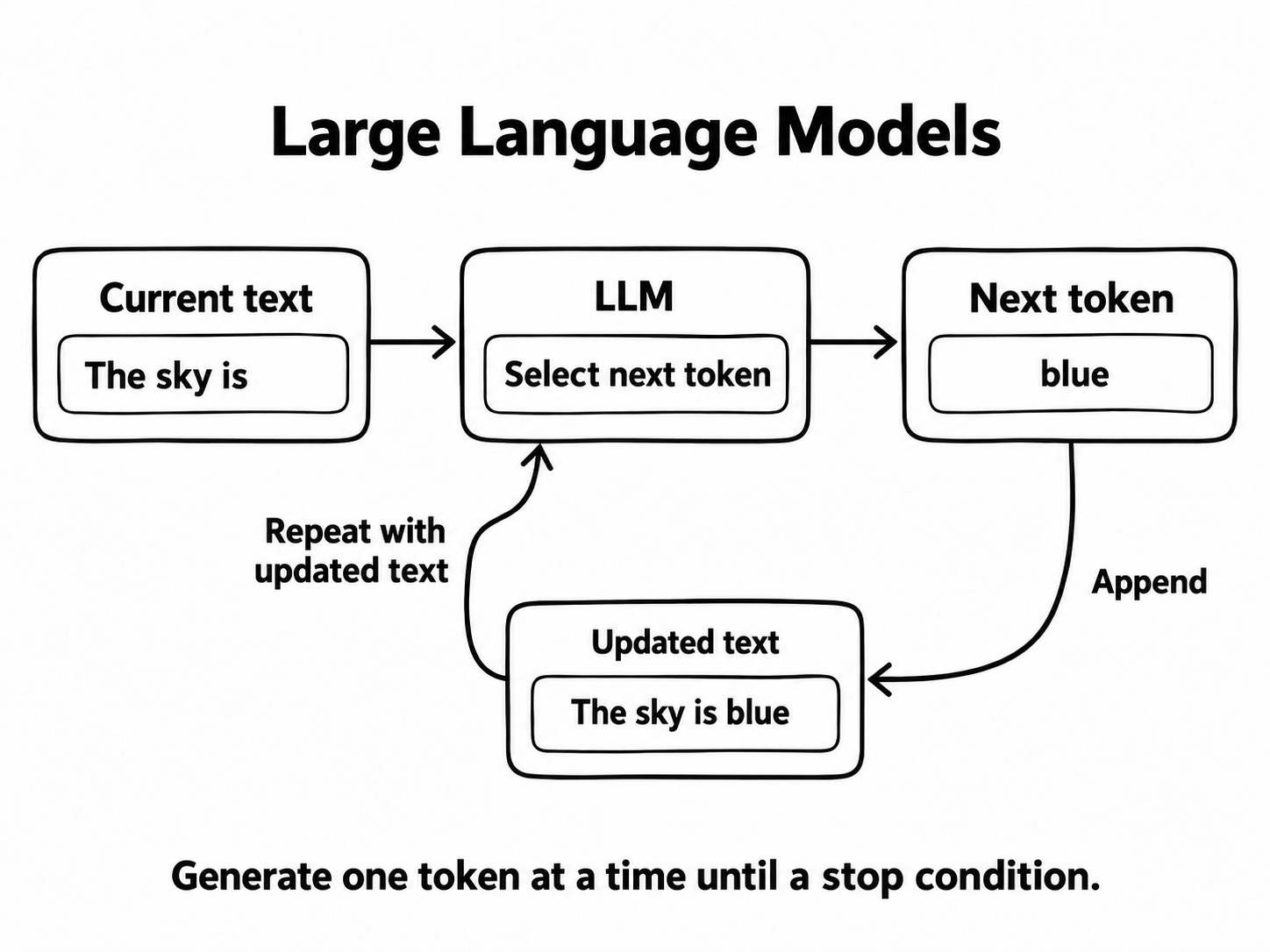
The model processes your question as small pieces of text called tokens. A token could be a word, part of a word, or punctuation. A typical text-generating LLM selects the next token based on your question and the text it has produced so far.
Then it repeats. Token by token, the answer appears…
During training, the model adjusted internal numerical values called weights. Those weights capture patterns useful for language tasks, from sentence structure to relationships between ideas.
Your prompt gives the model context for its response.
Analogy
Think of autocomplete on your phone:
You type “See you,” and the keyboard suggests “soon.” An LLM takes this idea much further, using the available conversation to produce paragraphs, explanations, or code.
Predicting a plausible continuation still leaves room for a wrong answer.
Common mistake
Trusting an answer simply because it sounds confident.
Suppose you ask for code to resize an image. The model could suggest a function with a sensible name that the library doesn’t provide. Check the documentation & run the code before you rely on it.
Why it matters
You don’t need a separate model for every language task.
Different instructions let the same LLM summarize a document, explain an error, or draft a reply.
That flexibility makes LLMs useful across many software products.
2. Generative AI
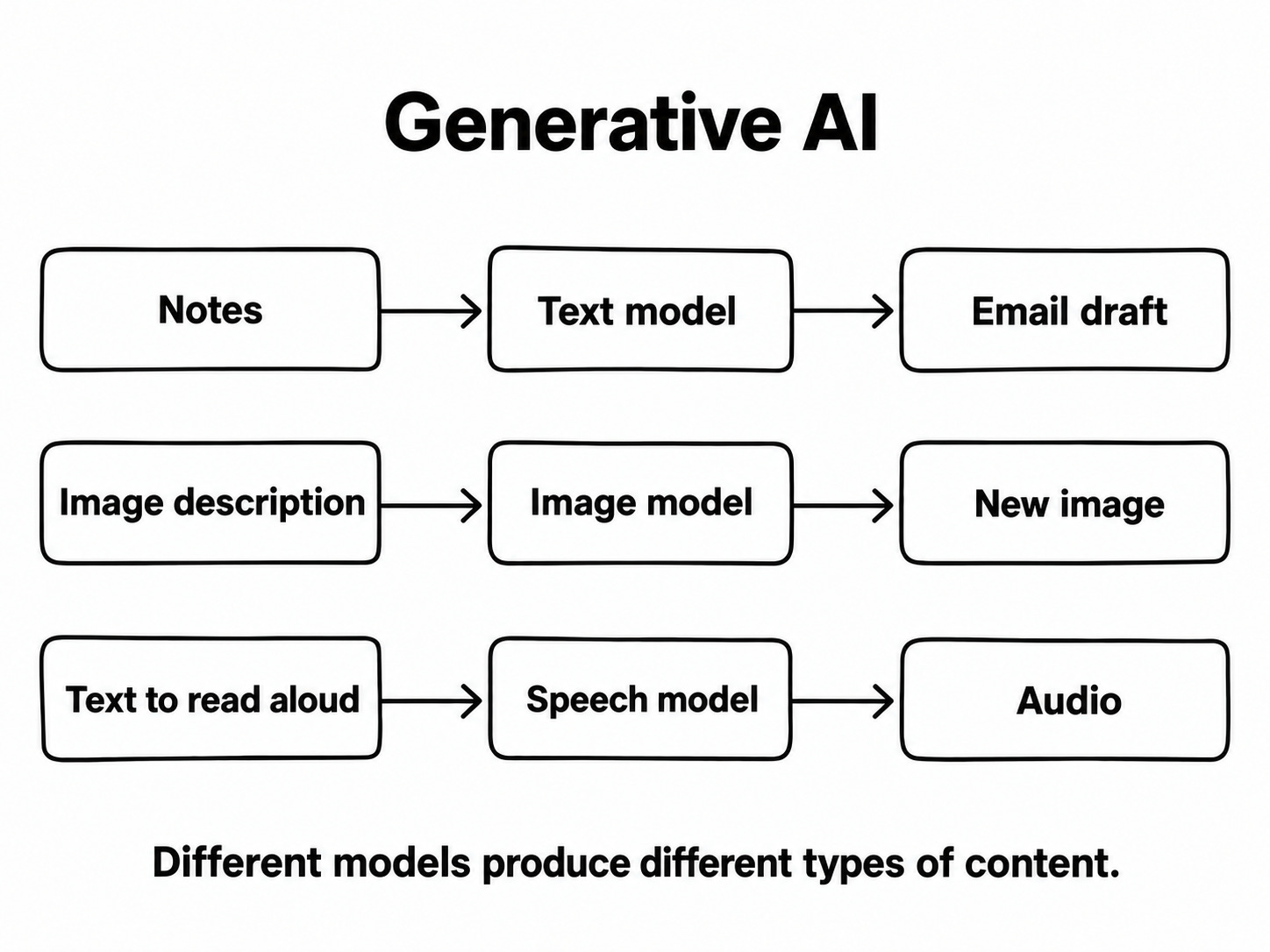
Generative AI produces content such as text, images, audio & video from patterns learned during training.
Ask an image generator for “a red bicycle outside a bakery.”
Your description guides the model toward a result. Some image models begin with random noise and refine it step by step into an image. A text model uses a different process, typically selecting tokens in sequence.
Both produce content from learned patterns.
Generative AI is the broader category… Text-generating LLMs are one example; image and audio generators are others.
Analogy
Think of a cook who has learned from hundreds of recipes:
You ask for a spicy vegetable dish. The cook draws on familiar ingredients and techniques to prepare something that fits your request.
You still taste the dish before you serve it.
Common mistake
Assuming the generated content is ready to use.
An image could contain unreadable labels. A summary could leave out a key decision. Review the result against your original request and check factual details against the source.
Why it matters
Generative AI helps you get from a blank page to a first draft.
A few notes become an email, a description becomes an illustration, or a specification becomes starter code.
The next step is to check whether the draft does the job.
3. Machine Learning
Machine Learning (ML) is a branch of AI in which systems learn from data to perform tasks without explicit rules for every situation.
Think about the spam folder in your inbox:
You could write a rule to block every email containing “free money.” But a spammer could change the wording; also, a legitimate email could contain the same phrase. A model learns from examples & considers several clues together.
Those clues help it assess a new message.
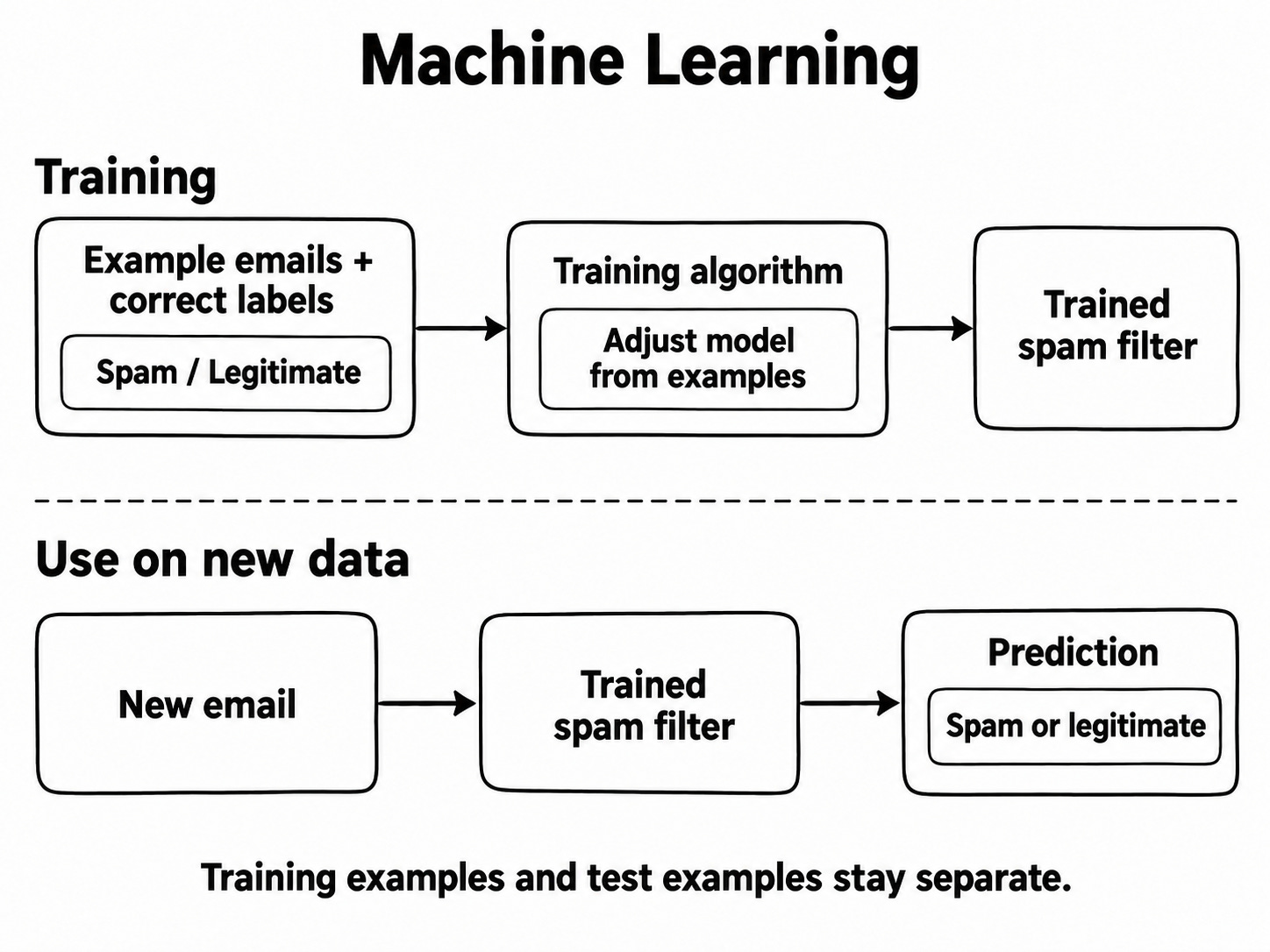
For a spam filter, training examples typically include the correct label: spam or legitimate. The training algorithm adjusts the model to reduce classification errors.
This approach is called supervised learning.
Other approaches discover patterns in unlabeled data or learn through rewards after actions.
Analogy
Think about how you learn to choose ripe fruit:
Someone shows you a few good examples & a few bad ones. Over time, you connect color, firmness, and smell with ripeness.
You use those clues on your next trip to the market.
Common mistake
Testing the model with the same examples it learned from.
That’s like giving a student the practice questions again and calling it a final exam. Reserve separate examples to check whether the model handles unfamiliar data.
Why it matters
ML helps when a task involves more patterns than you could reasonably capture in hand-written rules. It powers uses such as spam filters, fraud detection, and product recommendations.
The goal is useful predictions on new data.
§
§
4. Deep Learning
Deep learning (DL2) is a type of ML that uses multiple layers of a neural network to learn complex patterns.
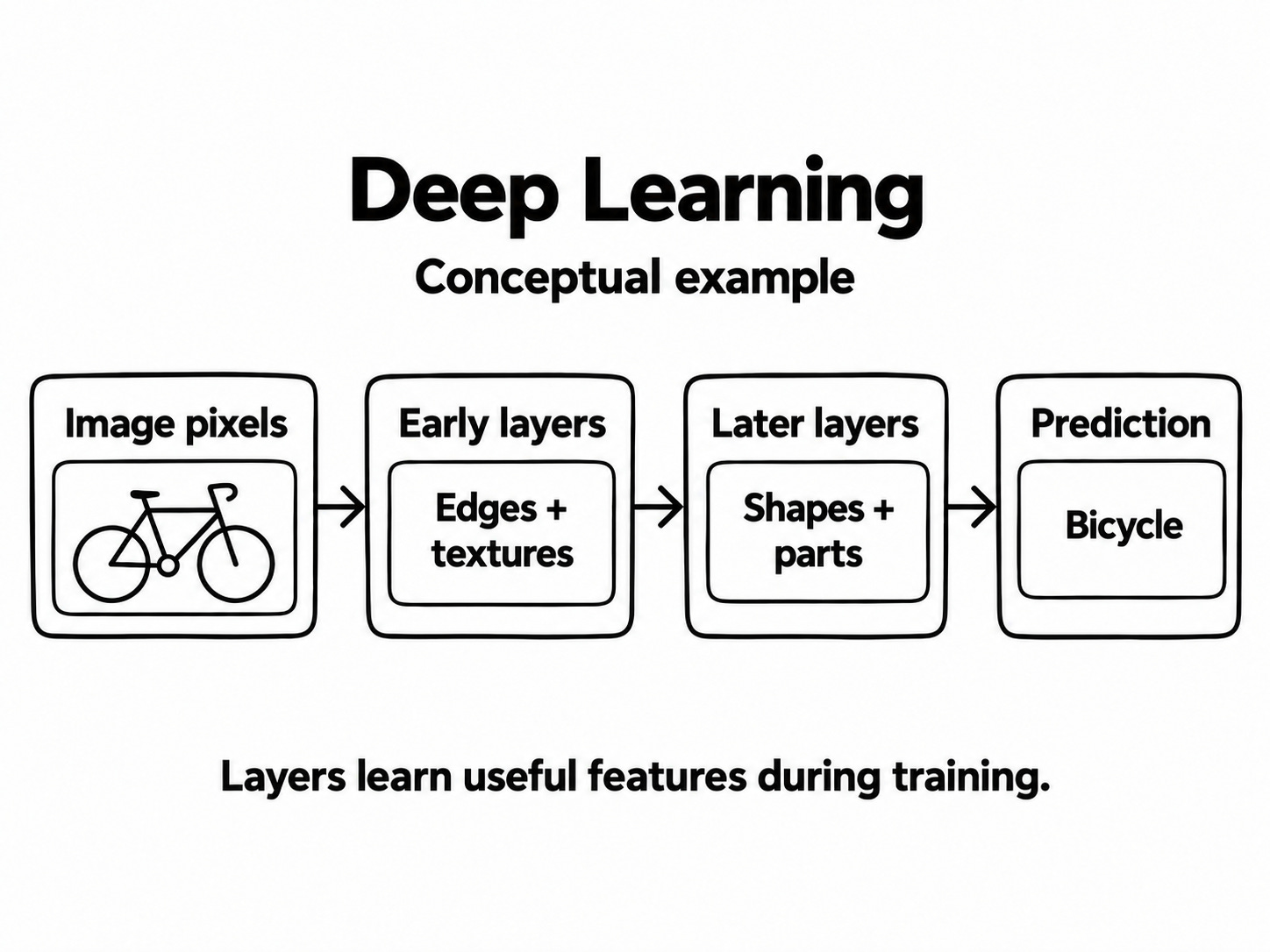
Show a model a photograph of a bicycle.
The model receives numbers representing the image’s pixels. Early layers often detect simple features, such as edges & textures. Later layers combine these features into more complex shapes & object parts.
Together, the layers help the model recognize the bicycle.
The word “deep” refers to these multiple layers. During training, the model adjusts them to improve its predictions.
Analogy
Think of a sketch as someone draws it:
First, you see a few lines and circles. Add a frame, handlebars, and pedals, and the shapes start to make sense together.
A deep network also combines simpler features into more complex patterns.
Common mistake
Assuming every problem needs deep learning.
For a small spreadsheet of house sizes and prices, a simpler model could do the job well. Test a basic approach first, then compare whether a deep network earns its extra cost and complexity.
Why it matters
Images, speech & language contain patterns which are difficult to describe with fixed rules. Deep learning helps models learn useful features from these inputs.
It underpins tools such as speech recognition & image classification.
5. Neural Networks
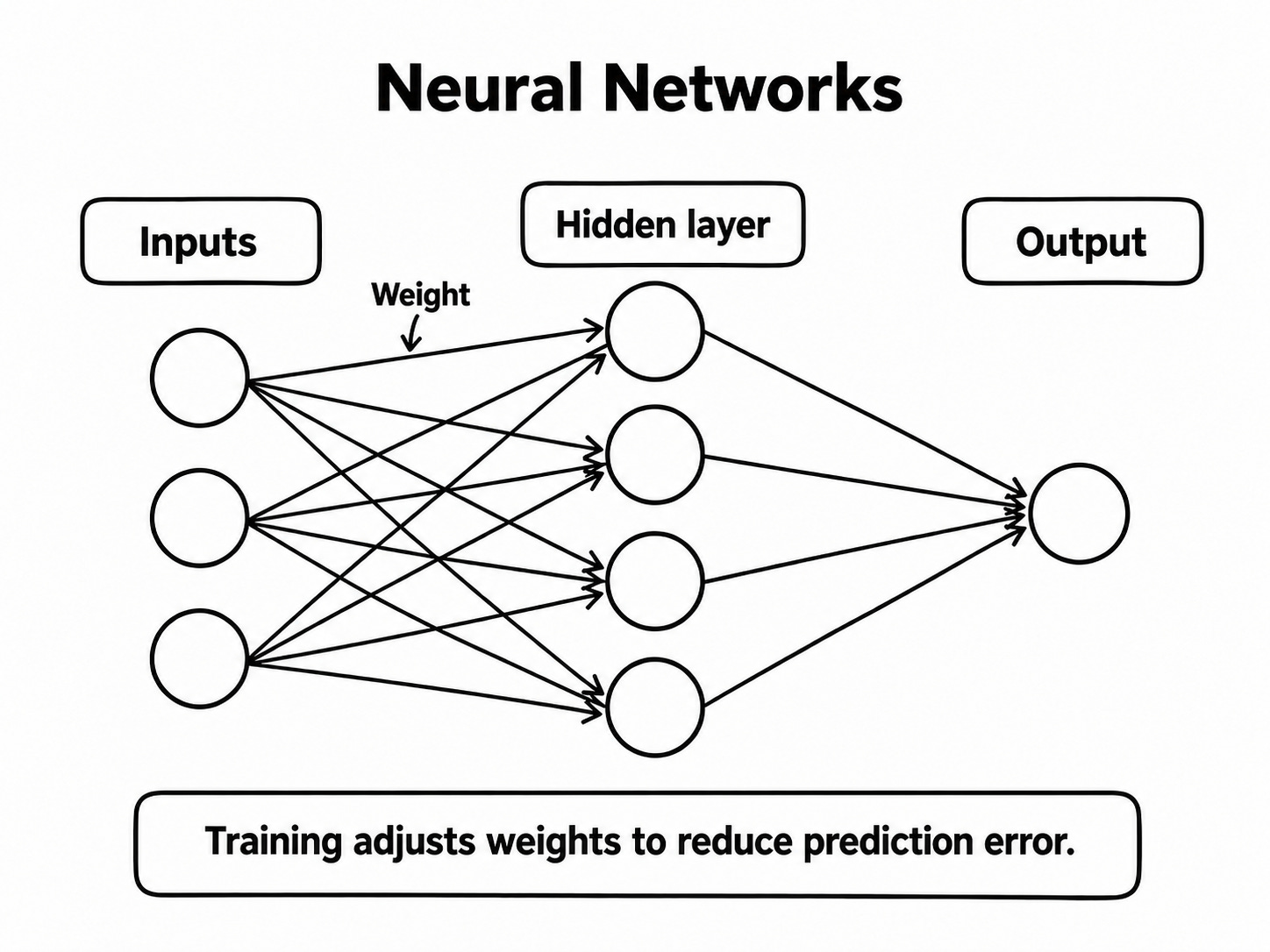
A neural network3 is a model made of connected mathematical units that transform inputs into an output.
Let’s look inside the layers we just discussed:
Each unit receives numbers, combines them, and passes a result onward. Connections have adjustable values called weights, which control how much each input contributes. Layers also apply transformations, so the network learns more complex relationships.
The final layer produces the model’s output.
During training, an error measure tells the system how far its predictions are from the target. The training algorithm uses this feedback to adjust weights and other values across the network.
Tiny adjustments, repeated across many examples, change its predictions.
Analogy
Think of the controls on a sound mixing desk:
One control increases the voice; another reduces the drums. Changing the controls changes the final sound.
Weights play a similar role in how a network combines its inputs.
Common mistake
Taking the word “neural” too literally.
The name draws inspiration from the brain, but these units perform mathematical operations. A network’s ability to recognize a face or produce a sentence doesn’t establish human-like thought.
Why it matters
Neural networks provide the structure behind deep learning.
Understanding weights also explains what training changes: numerical values a model uses to turn an input into a prediction.
6. Retrieval-Augmented Generation
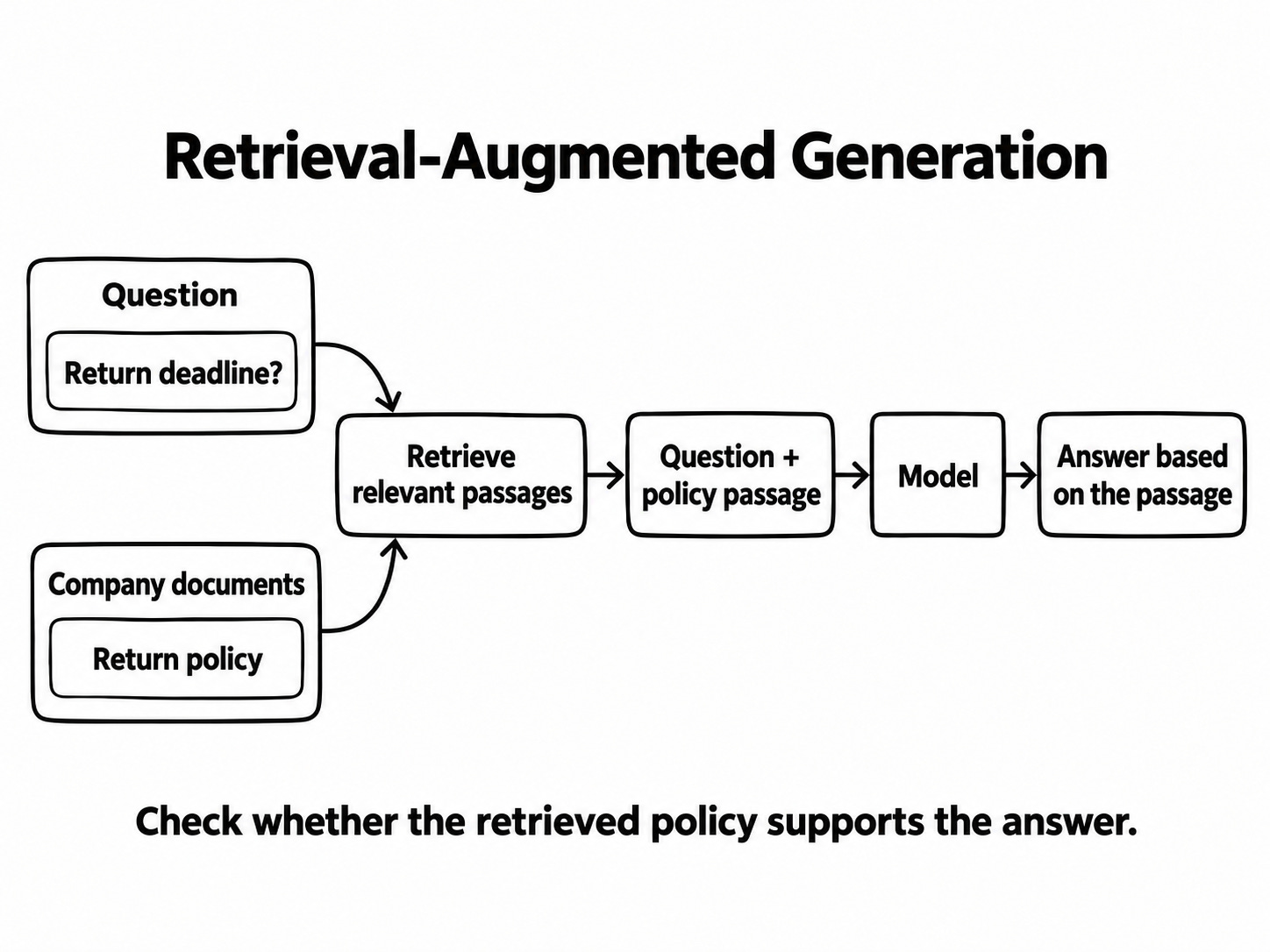
RAG is an approach that retrieves relevant information & supplies it to a model to help generate an answer.
Ask a company assistant, “How long do I have to return this order?”
The application searches the company’s documents for the relevant return policy. It places matching passages alongside your question. The model uses those passages to write its response.
The answer has information from the company’s documents.
Updating those documents gives the application new material to retrieve. It doesn’t require a new training run for every policy change.
Analogy
Think of an open-book exam:
You find the relevant pages before you answer. Your result depends on both finding the right material & interpreting it correctly.
Common mistake
Assuming retrieval guarantees a correct answer.
The search could return an outdated policy and/or miss an exception. So check the retrieved passages & final response. When the evidence is missing, the assistant should say so.
Why it matters
RAG helps assistants answer questions about private or frequently updated information. Also it gives readers source material to check against the answer.
7. AI Agents and Agentic Workflows
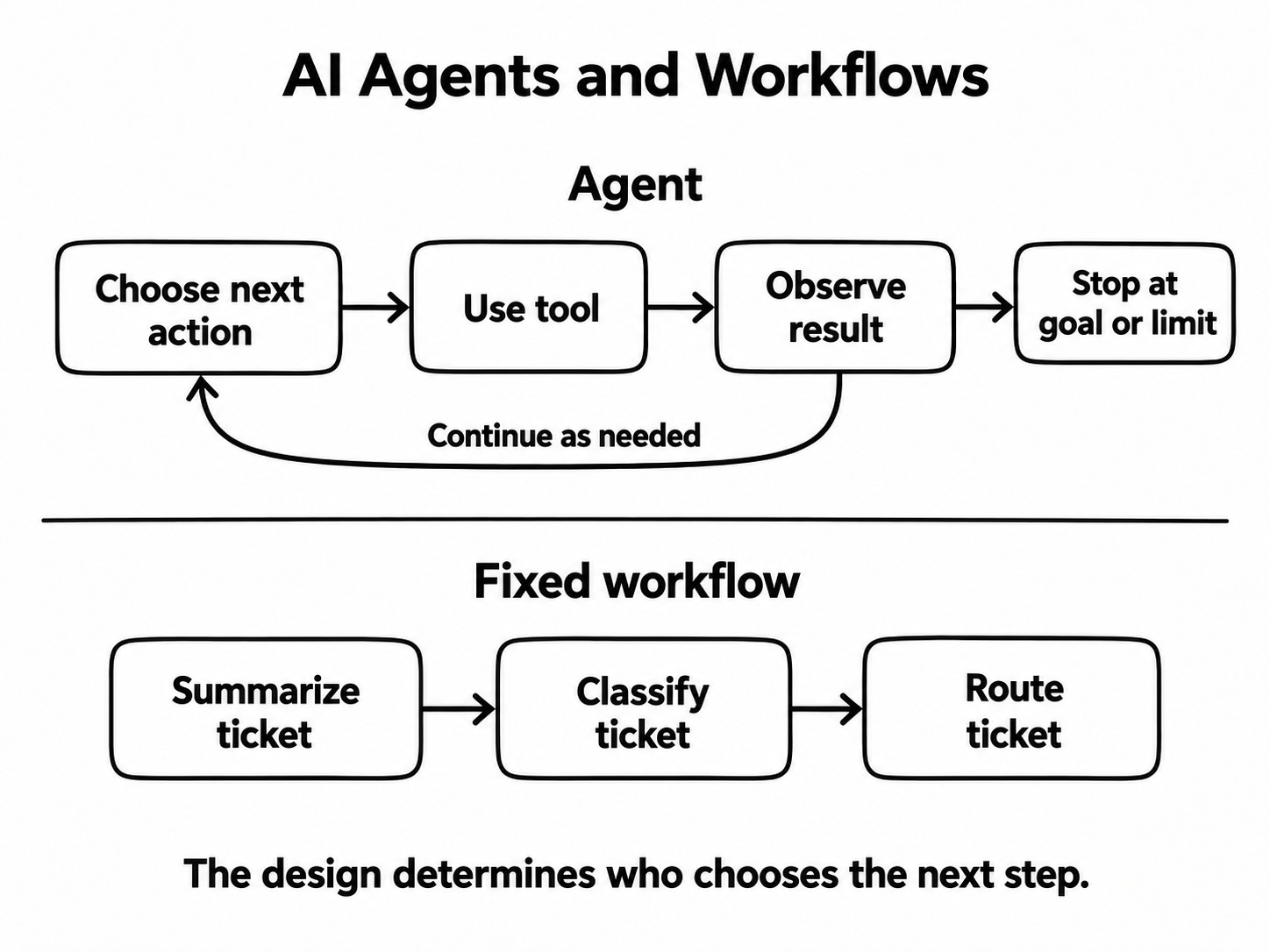
An AI agent uses a model to choose actions toward a goal and respond to the results. Agentic workflows organize model and tool steps into a process.
Ask an assistant to investigate a failed software test.
An agent would inspect the error, open a file, make an edit, and rerun the tests. The result helps it decide what to do next. A fixed workflow follows a prewritten sequence, such as “summarize the ticket, classify it, then route it.”
The difference is how much control the model has over the next step.
The term “agentic workflow” covers a range of designs. Some follow mostly fixed steps; others give the model more freedom to choose.
Analogy
Think of a technician with a checklist:
For a routine inspection, the checklist determines the order. For an unfamiliar fault, the technician chooses the next check based on what the previous one revealed.
Common mistake
Giving an agent tools without clear limits.
A failed action could trigger repeated retries/unwanted changes. So set permissions, spending limits, and stopping conditions. Plus, require approval before consequential actions, such as a payment/deletion.
Why it matters
Agents help with tasks whose steps depend on discoveries along the way.
Fixed workflows work when the sequence is known and predictable execution matters.
§
Reminder: this is a teaser of the subscriber-only newsletter series, exclusive to my golden members.
When you upgrade, you’ll get:
Simple breakdown of real-world architectures
Frameworks you can plug into your work or business
Proven systems behind ChatGPT, Perplexity, and Copilot
Ready for the best part?