



Share this post & I'll send you some rewards for the referrals.
You’ve prepared for the technical interview…You’ve solved the system design problem…You’ve written clean code…
Yet the hiring decision often comes down to something completely different: “your behavioral interview”.
This is the conversation where the interviewer asks, “Tell me about a time when you disagreed with your manager,” or “Describe a situation where you had to make a decision with incomplete information.”
It’s where they assess not just what you can build, but how you work, how you think, and how you’ll show up in their organization.
Onward.
Need public web data, without scraper headaches? (Partner)

SerpApi turns search results into predictable JSON with built-in scale, location options, and protection from blocks.
That’s why engineers use it to ship:
AI applications
Product research
Price tracking
SEO insights
All without maintaining scrapers or infrastructure.
I want to introduce Prasad Rao as a guest author.

He is a Principal Solutions Architect and co-founder of a FREE group mentoring initiative, BeSA - Become a Solutions Architect to help people excel in their cloud and AI careers. The next free mentoring cohort starts on 21 Feb and focuses on Agentic AI on AWS.
Check out his LinkedIn, newsletter, and offerings:
Big Tech Careers (flagship newsletter to develop your behavioral skills)
Big Tech Interview preparation course - If you’re preparing for interviews, I highly recommend this course as it focuses specifically on behavioral interviews, setting it apart from other courses. You can use code NEO25 for 25% off.
Why Behavioral Interviews Matter
Let’s dive in!
Ask any experienced interviewer at Big Tech why candidates fail their interviews.
Their #1 reason is consistent:
“Smart technical professionals who can’t clearly articulate their past work. They ramble too much, miss the main points, and can’t explain their decision-making process.”
For many engineers, this feels unfair…
You’re hired to write code, not to tell stories. But behavioral interviews exist for a reason, and understanding that reason changes everything about how you prepare.
What We Mean by Behavioral Skills
Before we dive deeper, let’s clarify what behavioral skills actually are:
These are your personal attributes and interpersonal abilities that shape how you work, interact with others, and approach challenges. Unlike technical skills, which are specific to a particular job or industry, behavioral skills are transferable across various roles and sectors.
You might be an exceptional backend Java programmer, but that skill won’t directly transfer to a data engineer role… Your ability to handle conflict, though? That transfers everywhere. Your capacity to make decisions with incomplete information? That applies in any organization.
This is why companies prioritize these skills.
Why Companies Care About Behavior
Technical skills are table stakes.
Any engineer applying to a senior role can solve problems and write decent code. What separates a senior engineer from a staff/principal engineer, or what prevents someone from getting stuck at the senior level for years? It’s how they operate in ambiguity, how they lead without authority, how they make decisions that affect hundreds of engineers, and how they communicate complexity to non-technical leaders.
These are behavioral competencies…and they’re harder to assess in a coding or system design interview.
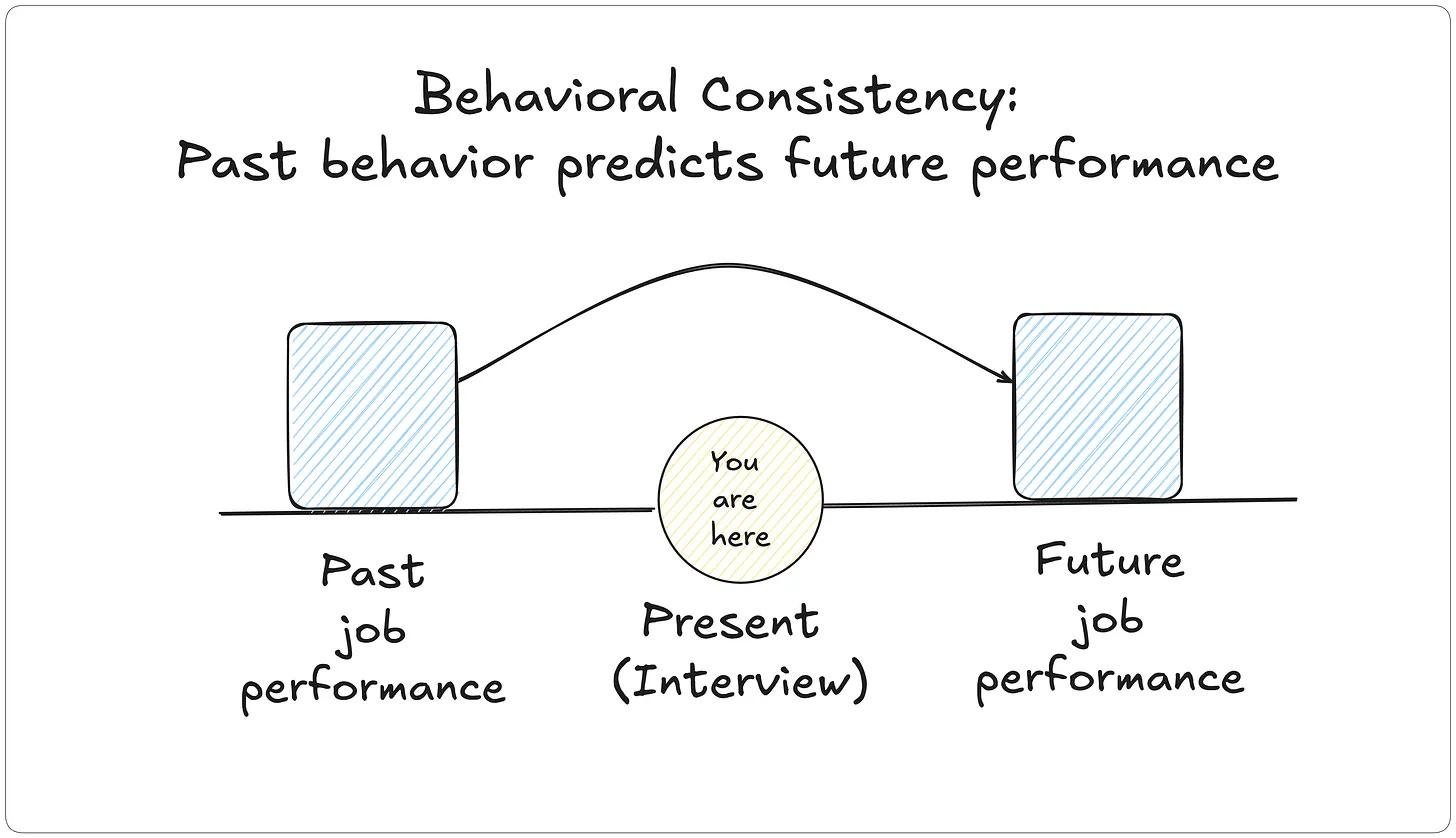
The primary reason employers focus on behavioral skills is that past behavior is often the best predictor of future performance. This concept, known as “behavioral consistency,” is a fundamental principle in psychology and human resources.
Behavioral consistency suggests that the way a person has behaved in the past is likely to be consistent with how they will behave in the future, especially in similar situations.
By asking about how you’ve handled situations in the past, interviewers get a sense of how you’re likely to act in similar scenarios if hired.
A behavioral interview is a risk-mitigation tool for the hiring manager.
When they ask about a conflict you resolved, they’re trying to understand:
Do you listen?
Do you escalate appropriately?
Do you compromise or dig in?
Do you think about the other person’s perspective?
For example, if you can describe a time when you successfully resolved a conflict with a manager, it suggests you’ll be able to handle such situations in the new role as well. This gives employers confidence in your ability to navigate workplace challenges.
If you’ve successfully led a team project in the past, you’re likely to demonstrate good leadership skills in future team projects. If you’ve shown creativity in solving problems at your previous job, you’re likely to bring that same innovative thinking to new challenges.
How Behavioral Interviews Evaluate Seniority
Here’s something most engineers don’t realize: same behavioral question is asked to candidates at different levels, but the bar changes dramatically.
Same question. Completely different answers. The difference is scope, self-awareness, and impact.
Interviewers check behavioral responses for key signs.
They want to see if you understand complexity. They also look for how well you’ve handled ambiguity. Learning from mistakes is important as well. Finally, you need to communicate all this clearly.
As you climb the ladder, they want to see that you can make decisions for larger groups. They look for your ability to influence others without authority. Also, they want to know if you consider the organization’s impact, not just technical correctness.
Behavioral interviews are a gating mechanism:
Companies use them to calibrate your level. Get them right, and you move up. Get them wrong, and you get downleveled—placed in a role one or two levels below what you applied for.
Downleveling happens when your behavioral responses don’t match the seniority you’re targeting. You may have the skills for a staff role, but your stories matter. If you sound junior—focusing on your own work instead of the impact, or lacking proof of handling uncertainty or influencing others—then you might get a senior role instead. Same company, same team, potentially 20-30% lower salary, and a much slower path to where you wanted to be.
This is why behavioral interviews matter more than most engineers realize. They’re not a soft skill afterthought. They’re the primary mechanism through which companies evaluate whether you’re ready for the level you’re targeting.
Technical skills get you hired. Behavioral skills get you hired at the right level.
What This Playbook Will Do
Over the next few sections, you’ll learn how you should be preparing for your behavioral interviews.
You’ll master the STAR framework—the real version, not the generic one you’ve likely heard. This one actually prevents downleveling. And you’ll see real examples of answers that landed offers at Big Tech companies.
More importantly, you’ll learn to think like an interviewer. When you understand what they really want to hear, you can tell stories that address their true questions. These aren’t just surface-level questions. They go deeper, focusing on your judgment, impact, and readiness for the role.
The engineers who excel at behavioral interviews aren’t necessarily the best storytellers. They’re the ones who understand what’s being evaluated and can connect their experiences to those evaluation criteria.
To start, let’s understand when and how your behavioral skills are evaluated during an interview process.
When Behavioral Skills Are Evaluated
Here’s something that surprises most engineers: behavioral skills aren’t just evaluated during the dedicated behavioral interview round. They’re being evaluated from the very first question, often before the technical interview even starts.
Many candidates believe behavioral assessment happens in a separate block, usually near the end of the interview process.
In reality, hiring teams are evaluating your behavioral competencies across every single interview. Your ability to be hired at the right level depends on consistent performance across three distinct evaluation moments. Each one needs different preparation.
Three Moments When Behavioral Skills Are Evaluated
First, there’s the opening conversation…
This starts with your recruiter call and continues into the first technical interview. Then, behavioral evaluation occurs throughout your technical interviews. Finally, there’s the dedicated behavioral interview round.
Each moment assesses different aspects of your competencies and requires different strategies.
Most engineers focus only on the third moment…
They prepare answers to “Tell me about a time when...” questions but neglect the other two. This is a critical mistake. The interviewer who speaks to you first forms an impression that influences how every other interviewer perceives you. The technical interviewer who watches you explain your architectural choices is simultaneously assessing your judgment and decision-making process. By the time you reach the dedicated behavioral round, the narrative about you is already partially written.
Let’s look at each moment, what’s being evaluated, and how to prepare…
Moment 1: Tell Me About Yourself
The question “Tell me about yourself” appears everywhere.
It’s asked by the recruiter on your initial call.
It’s asked by the technical interviewer at the beginning of the coding round.
It’s asked by the hiring manager.
It’s asked by the panel interviewer before the system design discussion.
Some candidates face this question five times in a single interview loop, sometimes with slightly different framings like “Walk me through your resume” or “Tell me about your background.”
Most engineers completely underestimate its importance. When you’re asked, “Tell me about yourself,” the interviewer isn’t looking for your resume recited out loud.
They’re assessing several behavioral competencies simultaneously.
Can you communicate concisely?
Do you highlight impact or just responsibilities?
Do you show self-awareness about your growth?
Do you understand what matters for this specific role?
Can you tell a coherent story about your career progression?
Your answer shapes how the interviewer perceives you before any technical question is asked.
If you ramble for five minutes without clarity, they’ve already formed an impression... If you jump between random accomplishments without connection, they’re questioning your communication skills… If you focus entirely on what you did without explaining the impact, they’re seeing a junior mindset.
This first impression compounds throughout the interview.
Moment 2: Behavioral Skills During Technical Interviews
Many candidates don’t realize that behavioral assessment happens throughout technical interviews, not just when answering explicit behavioral questions.
During a coding interview, the interviewer might ask, “Why did you choose this data structure?” or “How would you optimize this further?” These are behavioral moments. They’re assessing how you think about tradeoffs, whether you consider constraints, how you handle feedback, and whether you communicate reasoning clearly.
During a system design interview, when you’re drawing architecture on the whiteboard, behavioral evaluation is happening constantly.
Can you explain your decision-making process?
Do you consider the viewpoint of your interviewer?
Do you ask clarifying questions before diving in?
Do you acknowledge tradeoffs, or do you present your solution as obviously optimal?
Do you listen when challenged, or do you defend rigidly?
The technical answer is only part of the evaluation. How you arrive at that answer, how you explain your reasoning, and how you discuss tradeoffs all signal your seniority level.
This is where the behavioral framework from later in this playbook becomes critical.
You need to communicate not just your solution, but your thinking process. You need to show scope, evidence of learning, and organizational awareness.
Moment 3: Dedicated Behavioral Interview Questions
It’s where you have the most time and space to demonstrate behavioral competencies in depth.
It’s where you seal the narrative that’s been building throughout the interview and get hired at the right level. (We will dive into how to prepare for behavioral interviews in this playbook.)
What This Means for Your Preparation
You need to prepare for all three moments, not just the behavioral round.
First, master your “Tell me about yourself” answer.
This is your opening act. Make it strategic, concise, and tailored to the role. Practice it until it feels natural, not robotic. Know multiple versions for different interview contexts.
Second, develop the ability to articulate your thinking during technical interviews.
Learn to explain not just what you decided, but why. Practice talking through your decision-making process, assumptions, and trade-offs. When an interviewer asks a clarifying question or pushes back, view it as a chance to show your thought process. It’s not an attack.
Third, prepare deep answers for behavioral questions using the frameworks we’ll cover in this playbook.
Have eight to fifteen strong stories ready. You can adjust them for different questions based on the company you’re interviewing with. Know the underlying behavioral competencies you’re demonstrating with each story.
The engineers who get hired at the right level aren’t necessarily the smartest in the room. They’re the ones who communicate clearly across all three moments. They tell a coherent story about their career, their judgment, and their impact from the first question to the last.
Let’s dive into frameworks for preparing for each of these 3 moments, starting from “Tell me about yourself.”
Framework to Answer “Tell Me About Yourself”
When an interviewer asks, “Tell me about yourself,” the interviewer is actually asking, “Tell me why I should hire you?”
So instead of focusing on your entire career experience, you need to focus only on the highlights of your career experience that are most relevant to the job role you’re applying for.
You need to have a 1-minute elevator pitch for yourself.
That one minute not only helps you connect with the interviewer but also steers the interview. You subtly drop in the keywords and your strong areas on which you would like the interviewer to probe further.
I understand keeping it under one minute is extremely difficult. You can have it as 2 min max.
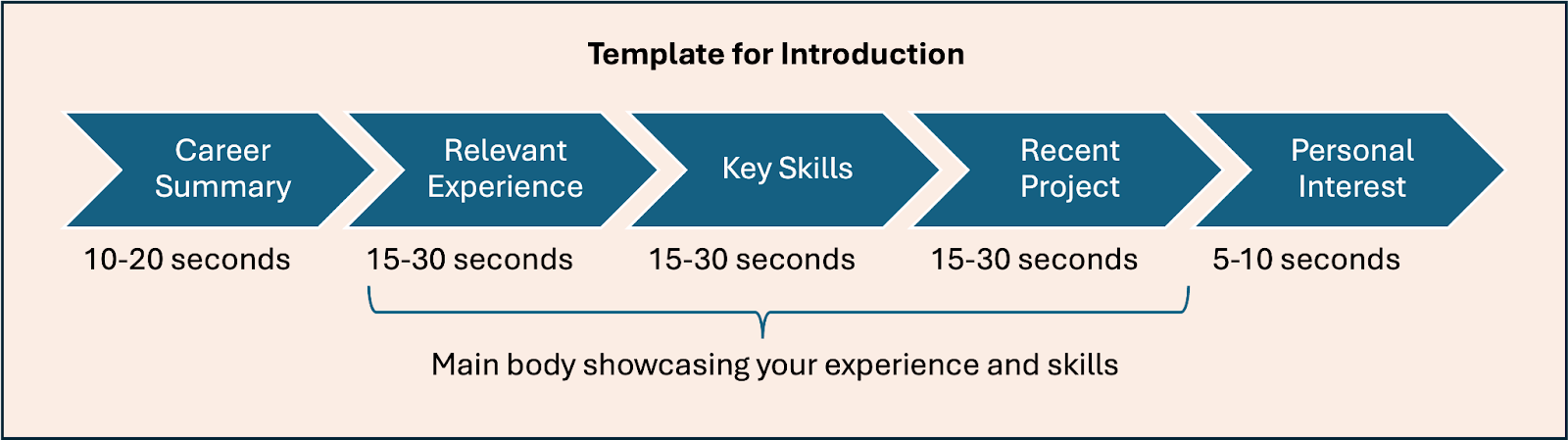
Here is the framework you can use to write your introduction:
Career Summary [keep it to 20 seconds max]
This is your hook to keep the interviewer engaged for the next 1-2 minutes as you power through your introduction.
Main Body [45-90 seconds]
This section should explain why you are a strong fit for the role. In no particular order or specific time allocation, talk about following:
Relevant Experience
Key Skills
Recent Project
You’ll notice in my example below that I start this section with a recent project, as it aligns with the role's experience requirements. I have not explicitly discussed key skills, but I have woven them into the two project examples I have provided.
Personal Interest [Optional. Keep it very short]
It’s a nice-to-have section where you can talk about what you do outside of your work.
As a mental model, to create your 1-2 mins introduction, you can use this flowchart:
Example of an Elevator Pitch
Let’s understand how you can put the framework I mentioned into action to write your own introduction using an example.
Here is the elevator pitch I used in my first technical round at AWS in 2019:
I started my career as a .NET developer, and over the last 10 years, I have gained extensive experience in developing and architecting applications using Microsoft workloads stack.
In my current project, I’m working as a tech lead helping a UK financial institution in digitally transforming their re-mortgage platform. Their legacy platform was built as a monolithic application in .NET with Winforms as frontend and SQL Server Database as backend. Their team was following the waterfall SDLC. I, along with my team, are helping them adopt agile development methodology and are modernizing their monolithic application by breaking it into microservices and implementing Jenkins CI/CD pipeline.
Prior to it, in my previous project, I was involved in building a product called the Compliance Management Reporting System (CMRS). The tech stack was .NET, SQL Server, XSLT, Biztalk, WCF, Winforms /WPF - basically it was all Microsoft stack. I started on the project as a senior developer and then became a track lead. Once that product was launched, I moved from India to London and joined the pre-sales team. I helped pitch the product to multiple financial institutions here and implemented it for them.
Outside of work, I enjoy running. Last month I ran the London Marathon. It was tough, but was an amazing experience to train for it and run alongside 40,000 runners.
I’m happy to dive deep into any of my experiences.
The pitch was in no way perfect. But it was specifically tailored for the job I was applying for and also the interviewer’s profile.
Job role:
I applied for the role of Senior Solutions Architect, Microsoft Dev tools. The role was to help AWS customers/partners migrate and modernise Microsoft Workloads (like .NET applications and SQL Server) on AWS.
Interviewer Profile:
I looked up the interviewer on LinkedIn. Before joining AWS, they were working as Application Development Lead at one of the Microsoft consulting company and had written a book on cross-platform .NET.
I didn’t have experience working with cloud/AWS at the time. My best approach was to leverage my strengths and highlight my experience developing applications on Microsoft workloads. As this was a customer-facing role, I discussed my pre-sales experience.
And it worked out pretty well…
Most of the technical questions were on .NET, SQL, application development, microservices, and CI/CD pipelines. In the behavioral question (yes, even in technical interviews, there are behavioral questions), I discussed a pre-sales experience with a major financial custodian.
Power of Customization
It’s easy to understand that an introduction needs to be tailored to the job role, but should it be tailored to the interviewer’s background?
If possible, yes!
For example, in my case, the interviewer had a .NET background, so I doubled down on that and mentioned the tech stack. Now, let’s say the interviewer had been from a Java background. I would have focused more on design patterns and my architectural skills rather than the Microsoft tech stack.
If the interviewer held a managerial or leadership position or came from a business background, I would have emphasized my business acumen and stakeholder management. I wouldn’t focus as much on my technical abilities.
It’s about finding common ground with the interviewer so the discussion can focus on topics we both know. Yes, it may be tedious, but you need to research the role and the interviewer and tailor your elevator pitch accordingly.
If you like to see more examples of introductions from other successful candidates, check out my Big Tech Interview Preparation course.
Next, let’s dive into how to showcase behavioral skills in technical interviews…
Standing Out in Technical Interviews using Behavioral Skills
Let me start this section with a personal anecdote.
In one of my technical interview rounds at AWS in 2019, I was asked, “What is an Idempotent API?”
My response was in 3 steps:
Answered the technical question asked upfront
I explained what an Idempotent API is, showcasing my technical knowledge.
Shared my previous project where I implemented an idempotent API
I showcased my actual hands-on work experience without the interviewer even asking me.
Explained my project experience in STAR format
[I’ll cover STAR (Situation Task Action Result) format in the next section]
While explaining my project experience in STAR format, I also explained WHY the idempotent API was required in that scenario. I talked about how the APIs I built were reporting trades worth millions in real-time to regulators and the reason I had to implement them as idempotent.
This is where I showcased my behavioral skills. I demonstrated I understand the business impact of the technical solutions I build.
The Problem with Pure Technical Answers
Many candidates show off their technical knowledge in technical interviews, and most get the technical answers right.
Let’s say 10 people interview:
7 of them answered the technical questions correctly. You’re one of those 7. So why should the interviewer pick you?
You need to stand out.
How? By sharing your real-world experience and behavioral skills.
While technical answers showcase that you have knowledge, they don’t paint a complete picture of your ability to succeed in a role.
For example, all engineers know what an idempotent API is. But how many can connect it to their experience in an interview and share real-world examples to boost the interviewer’s confidence in their skills? You stand out from other candidates by showing your experience and behavioral skills while you answer technical questions.
This also ensures that your interviewer does not downlevel you.
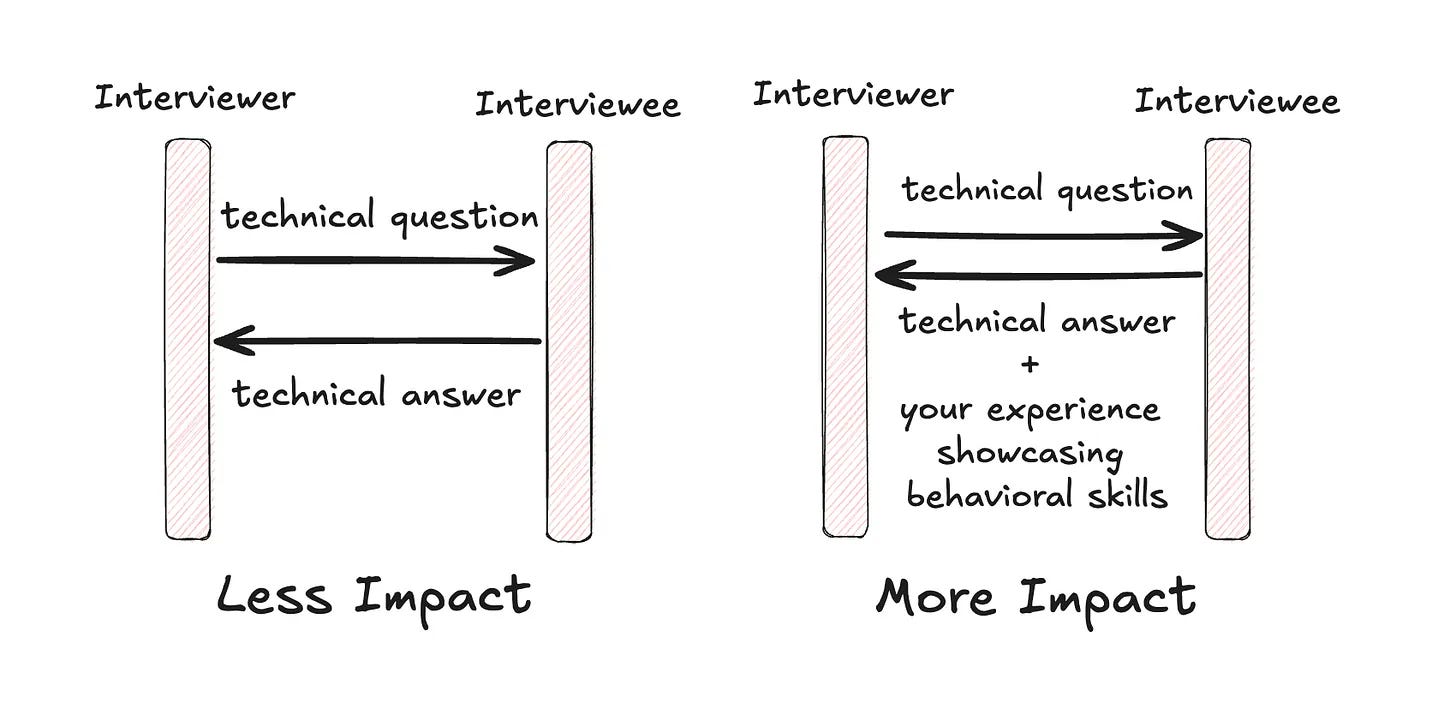
Let’s look at a couple of common technical questions…
I’ll show you how to answer them in a way that also shows off your behavioral skills and experience.
Question: “What are microservices, and what are their advantages and disadvantages?”
Purely Technical Approach
“Microservices are an architectural style where an application is built as a collection of small, independent services. The advantages include scalability, flexibility, and easier maintenance. Disadvantages include increased complexity and potential performance overhead due to network communication.”
(This is just an example. You’ll have your own version of a technical answer with much more depth to it!)
Behavioral Skills Showcase Approach
After you provide the technical answer, add your personal experience to it.
“In fact, in one of my previous projects when I was consulting for a manufacturing company in 2022, I led a team that modernized our e-commerce platform by transitioning from a monolith to microservices.
We decided to make this shift because our monolithic application was becoming increasingly difficult to maintain and scale. For instance, deploying even small changes required testing the entire application, leading to a release cycle of 6 weeks.
To begin the transition, I initiated and facilitated an event storming session with stakeholders from development, operations, and business teams. This collaborative approach helped us identify natural service boundaries and ensured buy-in from all departments.
We started by extracting the product catalog service, as it was relatively self-contained. We faced several challenges, such as increased operational complexity and data consistency issues. I saw these as opportunities for the team to learn and grow. We invested time in upskilling, bringing in external experts for workshops on distributed systems and organizing internal knowledge-sharing sessions.
I’m happy to dive deep more into my experience. I’ve seen firsthand in this project the advantages of microservices and the challenges that come along with it.”
This response not only demonstrates technical knowledge but also showcases your experience and several behavioral skills:
Leadership: Leading the modernization project
Communication: Facilitating sessions with various stakeholders
Problem-solving: Addressing challenges that arose during the transition
Learning mindset and adaptability: Learning and applying new technologies
Now, let’s look into another question.
Question: “What factors would you consider when choosing between SQL and NoSQL databases?”
Purely Technical Approach:
“When choosing between SQL and NoSQL databases, several factors come into play.
Data structures are a primary consideration, with SQL being ideal for structured, relational data, while NoSQL is better suited for unstructured or semi-structured data.
Scalability needs often favor NoSQL, which typically scales horizontally more easily.
SQL databases offer stronger ACID compliance and excel at complex queries involving joins and transactions. However, NoSQL databases provide greater schema flexibility, allowing for more dynamic data models.
Performance requirements are also crucial, as NoSQL can offer faster read/write speeds for certain use cases.
Data consistency needs should be evaluated, with SQL providing immediate consistency and some NoSQL databases offering eventual consistency.
The choice ultimately depends on the specific requirements and constraints of the project at hand.”
This is a good answer and will probably make the cut. But as I mentioned, most candidates will be able to provide this level of answer. You need to strive to go above and beyond.
Behavioral Skills Showcase Approach:
I understand you cannot have work experience for every technical question asked in an interview. And that is absolutely fine. Complement the technical answer above with how you would approach such a scenario.
“To understand the requirements and constraints, I would organize a requirements gathering session with various stakeholders like the development team, product managers and, if possible, end-users. During this session, I would ask key questions such as:
How structured is the data? Do we need a fixed schema or flexibility for evolving structures?
What are our scalability requirements? What are the expected read/write ratios?
Do we need strong consistency for all operations, or is eventual consistency acceptable for some data?
What are our typical query patterns? Do we need complex joins and transactions?
How frequently will our data model change?
Once we have these answers, I would analyze them in the context of ACID (Atomicity, Consistency, Isolation, Durability) properties typically associated with SQL databases, and BASE (Basically Available, Soft state, Eventually consistent) properties often seen in NoSQL systems.
I would also consider the CAP theorem (Consistency, Availability, Partition tolerance) which states that in a distributed system, you can only have two of these three guarantees.
And most modern systems often benefit from a polyglot persistence approach, using different databases for different purposes within the same application.
For example:
PostgreSQL for user accounts and financial transactions, where ACID properties were crucial. MongoDB for storing product catalogs with varying attributes. Redis for caching and real-time analytics
This decision cannot be made in isolation. I would consider trade-offs of each approach, challenge assumptions and provide alternative viewpoints.”
This response shows several behavioral skills:
Analytical thinking: Systematically considering various factors
Stakeholder management: Involving different teams in the decision-making process
Communication: Organizing and facilitating requirements gathering and review sessions
Decision-making: Weighing pros and cons to arrive at a solution
By answering technical questions in a way that showcases both your technical knowledge and behavioral skills, you present yourself as a well-rounded candidate who can not only do the job but also work effectively within a team and contribute to the company culture.
Companies are looking for more than just technical expertise. They want employees who can communicate effectively, work collaboratively, adapt to changing circumstances, and drive innovation.
So, as you prepare for your next technical interview, reflect not just on your technical accomplishments, but also on how you’ve demonstrated these crucial behavioral skills in your work.
Now, let’s dive into understanding the STAR framework to prepare for your behavioral interviews…
Use STAR Framework Effectively to Answer Behavioral Questions
If you’ve been preparing for job interviews, you’ve likely encountered the STAR format.
It’s a powerful framework for structuring responses to behavioral questions. However, many candidates use this technique incorrectly, resulting in weak, unconvincing answers.
In this section, I’ll cover how to avoid common pitfalls and craft compelling STAR responses that will impress your interviewers.
As I explain the STAR format with an example and then go through more examples in the upcoming sections, I will adopt different personas.
I’ll start with the persona of a Cloud Solutions Architect, as that’s my current role!
What is the STAR Format?
Let’s have a quick refresher of what STAR stands for:
Situation: Context or background of your example
Task: Specific challenge or responsibility you faced
Action: Steps you took to address the task
Result: Outcomes of your actions
Now, let’s examine each component, identify common mistakes, and learn how to do it right with an example…
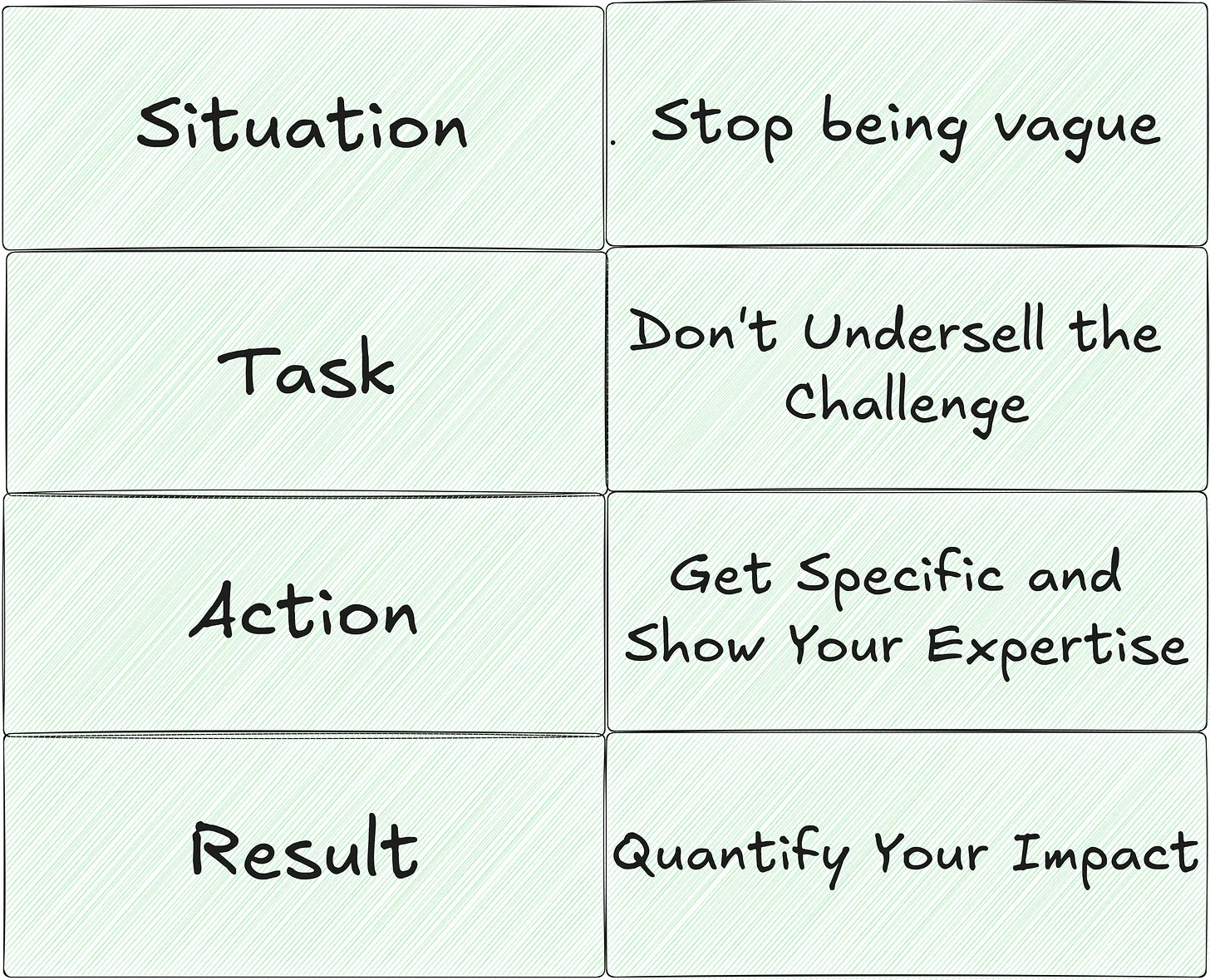
Situation: Stop Being Vague
Situation sets the stage for your story.
It provides the context and background information necessary for the interviewer to understand the circumstances you were facing. When describing the situation, be specific about:
Where you were working and what your role was
When the event occurred
Relevant data/metrics to showcase the importance of the situation
The Wrong Way:
“I was working as a Cloud Solutions Architect, and we had to move our mission-critical workloads to the cloud.”
This situation lacks specificity and fails to set the stage effectively. It doesn’t give the interviewer any meaningful context.
The Right Way:
“I was working as a Senior Cloud Solutions Architect with a Fortune 500 manufacturing company. In Q1 2023, 80% of our mission-critical applications were running on aging on-premises infrastructure, causing frequent outages and limiting our ability to scale. Our CIO had set an aggressive goal to migrate 50% of these applications to the cloud within six months to improve reliability and reduce operational costs.”
This approach works because it specifies the exact role and company, provides a clear timeframe, and offers relevant data and metrics that highlight the importance of the situation.
Task: Don’t Undersell the Challenge
Task describes the specific challenge, problem, or responsibility you were facing in a situation.
This component should clearly outline:
What you needed to accomplish
Goals or objectives you were working towards
Urgency and importance of the task
The Wrong Way:
“The task was to figure out how to move the applications to AWS within the given timeframe and make sure they worked properly.”
This description undersells the complexity of the task and fails to convey its importance or urgency.
The Right Way:
“The task was to identify, prioritize and migrate critical applications to AWS within six months. This required assessing applications, designing a secure architecture, creating a migration plan, minimizing operational disruptions, ensuring high uptime, and reducing costs. The timelines were aggressive, as the urgency was high because our aging infrastructure was putting us at risk of major system failures.”
This approach works because it breaks down the task into key components, emphasizes the urgency and importance of the challenge, and demonstrates the scope and complexity of what needs to be accomplished.
Action: Get Specific and Show Your Expertise
Action is the core of your response.
It details the steps you took to address the task or challenge. When describing your actions:
Be specific about what you did. Use “I” statements to clarify your personal contributions.
Explain your thought process and decision-making
Highlight any skills or qualities you demonstrated
The Wrong Way:
“I looked at our applications and decided to start the migration with our core ERP system as it was most critical. Then I set up the AWS accounts and worked with security, database, networking and other teams to migrate the application. We had to make some application architecture changes to make the apps work in the cloud.”
This description is vague, lacks detail, and does not demonstrate any specific skills or expertise.
The Right Way:
“To begin, I led a cross-functional team in conducting a thorough analysis of our application portfolio. We considered factors such as business criticality, dependencies, and architectural complexity to gain a complete understanding of our existing infrastructure.
Based on this assessment, I took the ownership to lead the migration of our core ERP system, which was critical to our manufacturing operations. This migration was also crucial to the overall goal as it would serve as a blueprint for future migrations.
I designed a multi-tiered AWS architecture for this application, ensuring high availability and scalability. Security was a top priority, so I collaborated closely with our security team to implement a robust model tailored to the ERP system’s requirements. I worked with the project manager to create a comprehensive project plan, including a phased approach to migrate different modules of the ERP system.
To streamline the migration process and reduce manual errors, I developed CloudFormation templates and leveraged AWS Migration Hub for automation. This significantly reduced migration time and improved consistency. Throughout the process, I worked closely with our database team to ensure data integrity and with our networking team to establish secure connectivity between our on-premises systems and AWS.
Additionally, I conducted several dry runs and extensive testing to minimize potential disruptions to our manufacturing operations.”
In the STAR framework, the Action section is where you should invest the most detail and time.
Detailing your actions, explaining your choices, and highlighting your technical and leadership capabilities builds a powerful story. It shows your impact and value.
Result: Quantify Your Impact
Result is the conclusion of your story.
It describes the outcome of your actions and their impact. When discussing results:
Be specific about what was achieved using quantifiable metrics when possible
Explain the positive impact on the company, team, or project
Mention any lessons learned or personal growth
The Wrong Way:
“We managed to move few applications to the cloud within the 6 months. The application is working better in the cloud and we overall reduced the cost of infrastructure of running these applications.”
This result lacks specificity and demonstrates no significant impact or value.
The Right Way:
“We successfully migrated our core ERP system to AWS in four months. The system’s response times decreased by 40%, and we improved scalability, handling a 200% increase in concurrent users during peak periods. We also reduced infrastructure costs for this application by 30%.
It took us more time than anticipated, but we learned a lot along the way. Based on the learnings, I created a blueprint, best practices document and SOP for other teams to migrate their respective applications. Using these documents, different teams have migrated 24 more applications so far.
Personally, this project deepened my expertise in large-scale cloud migrations and gave me the opportunity to work with multiple stakeholders and cross-functional teams.”
This approach works because it shows clear, measurable wins. It explains the good impact on various business areas and highlights your personal growth.
Now that you understand how to structure your behavioral answers using the STAR format, let’s explore the key themes you should focus on…
8 Key Themes to Prepare for Your Behavioral Interviews
Behavioral interviews can feel overwhelming because of their open-ended nature and the sheer volume of potential questions.
To streamline your preparation for your next tech company behavioral interview, I’ve organized these questions into eight main themes:
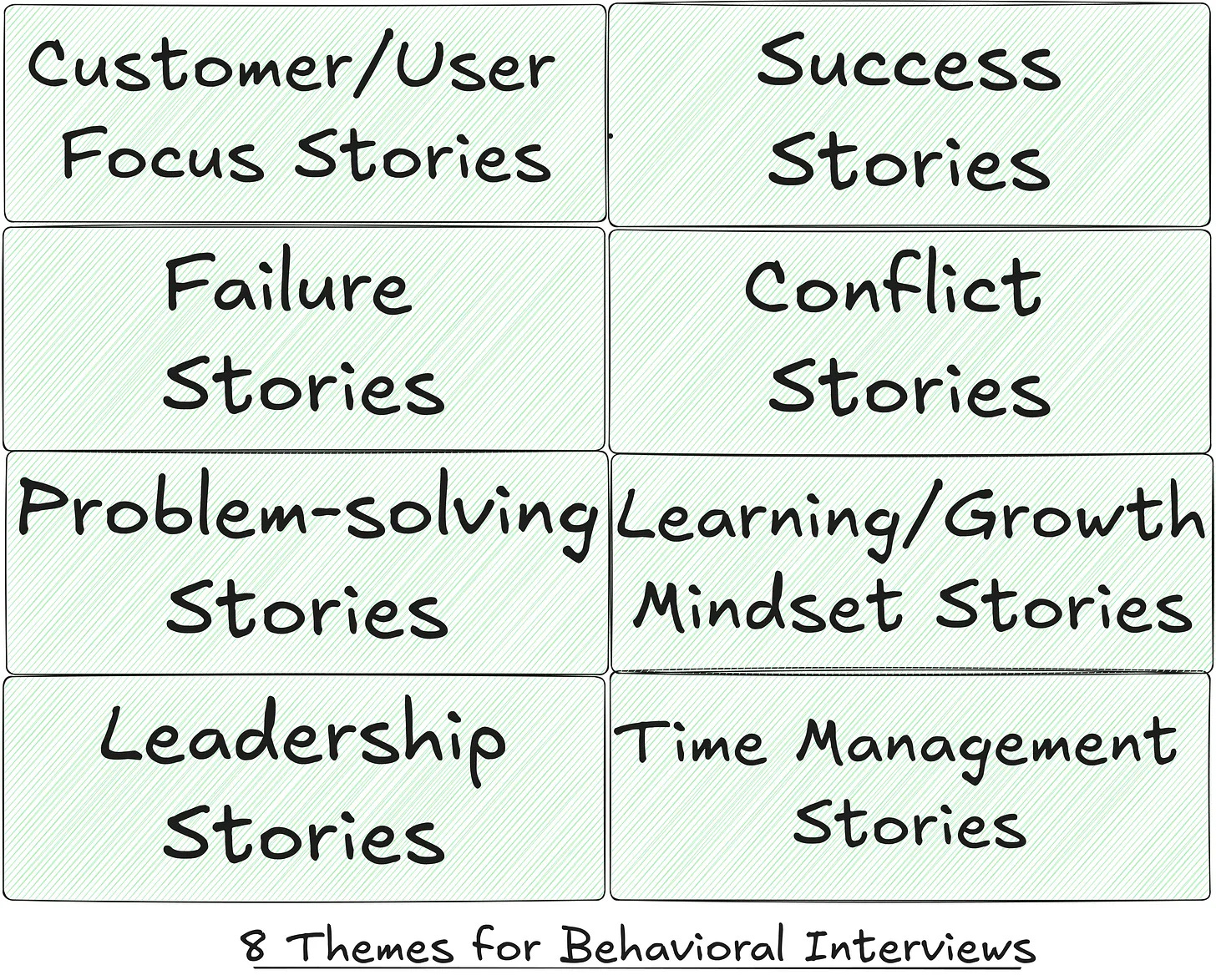
1. Customer/User Focus Stories
These stories showcase your ability to prioritize and enhance the customer experience. They might include:
Improving user experience
Handling customer complaints
Going above and beyond for clients
Example Question: “Give an example of a time when you had to deal with a challenging customer or user issue.”
What your answer should address: Describe the problem and why it was difficult to resolve, explain how you understood the customer’s needs, outline the steps you took to address the issue, and discuss the final resolution and how you ensured customer satisfaction.
2. Success Stories
The interviewers would like to hear about your ability to deliver results and handle challenges. Think about stories like:
Achievements and accomplishments
Overcoming significant challenges
Innovative solutions or improvements
Example Question: “Tell me about a time when you significantly exceeded expectations on a project or task.”
What your answer should address: Explain what the initial goals were and how you went above and beyond, describe the strategies you used to achieve results, and discuss how you measured your success.
3. Failure Stories
Interviewers are interested in how you handle adversity and grow from experiences. Prepare stories that showcase:
Projects that didn’t meet expectations
Mistakes with significant consequences
Failures to anticipate major problems or challenges
Example Question: “Tell me about a time when you failed to meet an important goal or deadline at work.”
What your answer should address: Describe the situation and the factors that contributed to the failure, explain how you handled the aftermath, and discuss the lessons you learned and how you’ve applied them since.
4. Conflict Stories
Interviewers want to assess your interpersonal skills and ability to navigate challenging situations. Prepare examples that showcase:
Dealing with difficult colleagues or clients
Resolving team disagreements
Navigating workplace dynamics
Example Question: “Describe a situation where you had a conflict with a colleague or team member.”
What your answer should address: Explain the source of the conflict and how you approached resolving it, describe the steps you took to maintain a professional relationship afterward, and discuss how this experience changed your approach to workplace conflicts.
5. Problem-Solving Stories
Interviewers aim to understand your analytical thinking and creative approach to challenges. Prepare examples that illustrate:
Tackling complex challenges
Making decisions with limited information
Implementing process improvements
Example Question: “Give an example of a complex problem you encountered at work that required an innovative solution.”
What your answer should address: Explain what made this problem particularly challenging, walk through your problem-solving process, describe how you implemented your solution, and discuss the result and how you measured its success.
6. Learning/Growth Mindset Stories
Interviewers look for examples of your adaptability and commitment to continuous improvement. Share examples that demonstrate:
Learning new skills quickly
Handling change or uncertainty
Embracing feedback for personal improvement
Example Question: “Describe a time when you had to learn a completely new skill or technology that was crucial for your role or a project.”
What your answer should address: Explain the situation and why this new skill was necessary, describe the challenges you faced and how you overcame them, and discuss how you applied this new knowledge and what the outcome was.
7. Leadership Stories
These anecdotes showcase your ability to guide, influence, and develop others:
Motivating and inspiring team members
Navigating conflicts or difficult decisions
Developing and mentoring others
Example Question: “Tell me about a time when you had to lead a team through a challenging situation or project.”
What your answer should address: Describe the context and the specific leadership challenges you faced, explain how you approached motivating your team and keeping them aligned towards the goal, and discuss the project outcome and how this experience shaped your leadership style.
8. Time Management Stories
Interviewers are looking to assess your ability to organize, prioritize, and deliver under pressure. Consider examples that highlight:
Meeting tight deadlines
Prioritizing tasks
Balancing multiple responsibilities
Example Question: “Describe a period when you had to manage multiple high-priority tasks simultaneously.”
What your answer should address: Explain what the tasks were and why they were all critical, describe how you prioritized them and your time, discuss the tools or techniques you used to stay organized, and explain how successful you were in meeting your deadlines and what you would do differently if faced with a similar situation.
For each theme, prepare one or two well-developed stories using the STAR framework.
Know the underlying behavioral competencies you’re demonstrating with each story. Then you can adapt these stories to different questions you encounter. Also, map the stories to the core values of the company you are interviewing for.
Want a free behavioral interview question bank with 40 questions in 8 themes? Subscribe to my newsletter, Big Tech Careers, and I’ll send it in your welcome kit.
Now, let’s examine a strong response from the Learning/Growth Mindset category.
Many companies value this theme. It shows how quickly you can learn new skills and adapt in a fast-paced environment…