


Get my system design playbook for FREE on newsletter signup:
This post outlines important rate limiting strategies. You will find references at the bottom of this page if you want to go deeper.
Share this post & I'll send you some rewards for the referrals.
Once upon a time, there was a tiny bank.
They had only a few customers.
And offered services through a mobile app.
Yet some people attempted to log in to customers’ accounts by guessing passwords.
So they solved this problem by blocking specific IP addresses using firewall rules.

But one day, their app became extremely popular.
And it became difficult to block many malicious IP addresses quickly.
So they set up request throttling.
It means slowing down requests instead of blocking them.
Yet it doesn’t stop abuse because someone could queue many requests and waste resources.
So they installed a rate limiter.
Rate limiting means controlling the number of requests a user can make within a time window.
For example, their app allows only 5 login attempts an hour by a user. While future attempts of the user get blocked until the time window passes.
This technique prevents abuse and server overload.
Imagine rate limiting as tickets to a movie theater. A show sells only 50 tickets. Once the tickets are sold, you’ve got to wait for the next showtime to get in.

Here’s how it works:
The user sends requests through a rate limiter
The rate limiter tracks requests from a user by their IP address, user ID, or API key
The extra requests get rejected if the limit exceeds (response status code:
429 Too Many Requests)The counter resets after the time window ends
Onward.
Vapi x MiniMax Free TTS API Week - Sponsor

Vapi is partnering with MiniMax for a free TTS API week.
Developers & builders can get:
• Free & unlimited access to all MiniMax voices until Sept 22
• 20% off MiniMax API for a year if you try it this week
• $10 Vapi credit with code VAPIMINIMAX10
Explore next-gen TTS with the free API now.
Rate Limiting
There are different strategies to implement a rate limiter.
Let’s dive in:
1. Token Bucket
It’s one of the most popular rate limiting strategies.
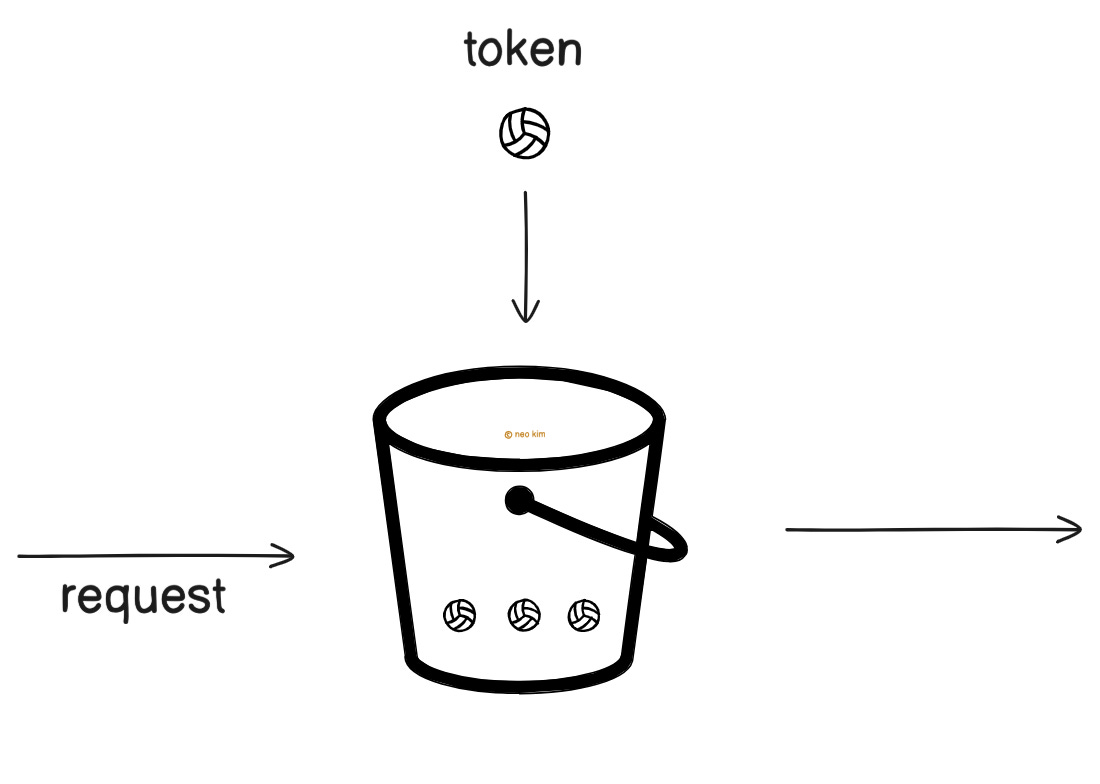
And here’s how it works:
Each user gets a bucket of tokens
And new tokens get added to the bucket at a fixed rate
While each request from the user needs 1 token to go through
The request gets blocked if the bucket is empty
This strategy is easy to implement and understand.
Also it allows spiky traffic. For example, imagine the bucket has 5 tokens and refills at 1 token per hour. A user can make 5 requests in a few seconds, but then they’d have to wait 1 hour to make an extra request.
Yet this strategy affects the user experience by making them wait a long time if new tokens get added slowly. While refilling tokens quickly might affect the security.
So it’s necessary to control the speed at which tokens get added based on the domain and server capacity.
2. Leaky Bucket
This strategy ensures fair usage of resources by smoothing traffic.
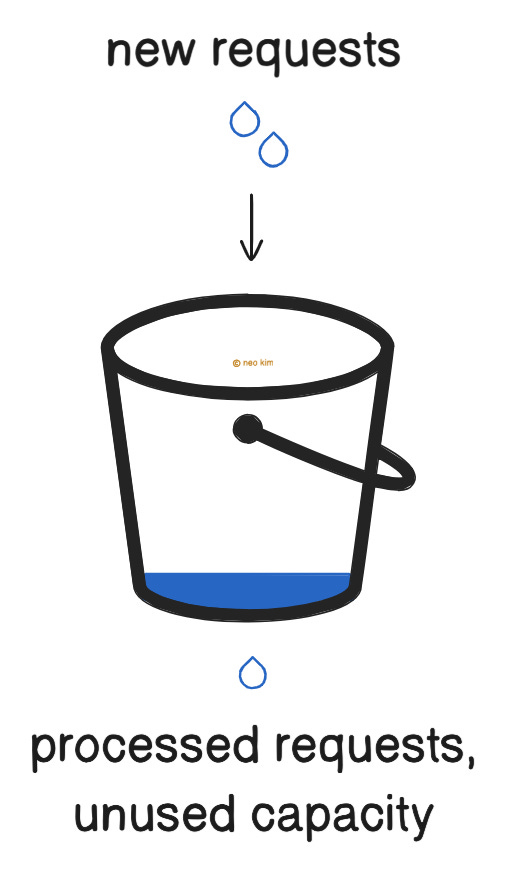
Here’s how it works:
Each user gets a bucket with a tiny hole at its bottom
Incoming requests are like water poured into the bucket
While water drips through the hole, which means a request got processed
Also water drips at a constant rate, even without new requests, representing server capacity
The bucket overflows if so much water is poured in quickly, which means rejected requests
Yet unused capacity gets lost even without processing requests with this approach.
Besides it’ll block requests during a traffic burst. So use this strategy when traffic is predictable, and when it’s okay to block some requests for users during a traffic burst.
Ready for the next technique?
3. Fixed Window
This strategy works well with predictable traffic.
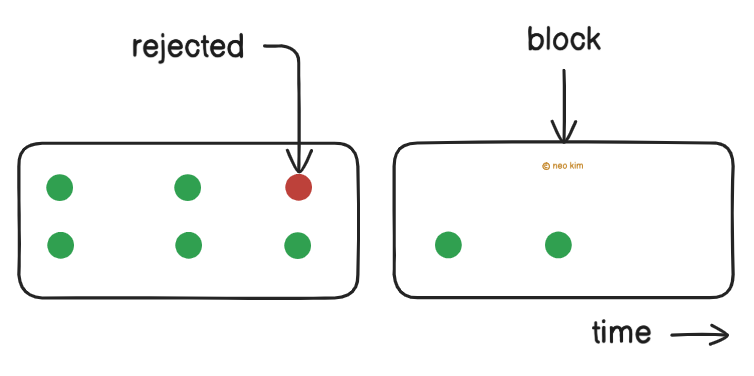
Here’s how:
Time gets divided into equal blocks; for example, 1-hour windows
Each block has a request limit: 5 requests per hour
Requests get counted within the current block
Extra requests get blocked if the count exceeds the limit
The counter resets to 0 when a new block starts
Although it’s easy to implement, it allows traffic bursts on window boundaries.
For example, a user could double their allowed requests by sending them at the end of one window and the start of the next. Thus overloading the server.
So use this strategy when the server can handle occasional traffic bursts.
Let’s keep going!
4. Sliding Window Counter
This strategy offers fairness and works better with traffic bursts.

Here’s how:
Define a rolling time window, for example, a 1-hour window
Each window has a request limit: 5 requests per hour
A counter then keeps track of the current and previous windows
The counter combines the current and previous windows to approximate the number of requests in the last hour
While a new request gets blocked if the count exceeds the limit
Put simply, it approximates the number of requests within the last hour from the current time.
Yet it’s more complex to implement than the fixed window, and the rate limiter count is approximate.
So use this strategy to rate limit efficiently in systems with moderate traffic.
5. Sliding Window Log
It’s like the sliding window counter, except it keeps a log of all request timestamps. Thus offering accuracy.

Here’s how it works:
A rolling time window gets defined, for example, a 1-hour window
Each window has a request limit: 5 requests per hour
Old requests outside the window get removed for each new request
The remaining requests inside the window get counted
A new request gets blocked if the count has already reached the limit
This strategy is precise and fair.
Yet it’s memory and CPU-intensive. So use it only when strict precision and fairness are necessary.
A rate limiter protects infrastructure from abuse and ensures high availability.
Yet it’s necessary to choose the right rate limiting strategy to avoid blocking users unnecessarily.
Also users from a building might share the same IP address. So it’s better to rate limit a person using an API key instead of their IP address for accuracy and fairness.
The right strategy for rate limiting depends on simplicity and the fairness needs.
A banking app needs precision and fairness. So it’s better to use the sliding window log strategy for it.
Subscribe to get simplified case studies delivered straight to your inbox:

Want to advertise in this newsletter? 📰
If your company wants to reach a 170K+ tech audience, advertise with me.
Thank you for supporting this newsletter.
You are now 171,001+ readers strong, very close to 172k. Let’s try to get 172k readers by 20 September. Consider sharing this post with your friends and get rewards.
Y’all are the best.

Some sample code examples would have made this article even better. Appreciate the effort, very helpful and informative 🫶
Loved the clarity here. Do you think most systems overdo rate limiting or don’t do it enough?