


Share this letter & I’ll send you some rewards for the referrals.
AI agents can write code…
But enterprise software is where things get HARD.
Imagine you ask an AI agent to move task notifications to a new system while preserving users’ existing notification preferences.
The AI agent writes code, runs tests…everything “passes”.
But a user who turned off email notifications now receives an email when someone assigns them a task.
The code passes tests, but it does NOT behave the way you want.
A simple fix is to give the AI agent1 a better prompt:
- Keep current email behavior intact.
- Preserve existing notification preferences.
- Do not change unrelated notification flows.
But a prompt has its limitations…
As the codebase gets bigger & agent takes on extra work, it creates 3 new serious problems:
1. Understand the existing system
A prompt describes what you want.
But it does NOT automatically explain how an existing system works. The agent must understand the architecture, dependencies, business logic, feature flags, APIs, data models & old behavior in the codebase (across repos).
Without this context, the agent would make a locally “correct change” that breaks something elsewhere…
2. Build the right change
If you add extra prompt instructions, the request becomes extremely difficult to manage.
The agent must then keep track of scope, constraints, edge cases, success criteria, & dependencies across the entire task. While a vague/incomplete instruction can quietly turn into a wrong implementation.
This could multiply the mistake across many files and/or tasks…
3. Trust autonomous work
Agent autonomy = more work you trust it with.
The agent would read more code, call more tools2, change more files, and run longer workflows. So you need controls on what it can access, what it can change, where it runs, how its output gets checked, and where a human must approve the work.
Yet a “longer prompt” does NOT solve any of these problems!…
§
Spec-Driven Development
Spec-Driven Development (SDD) is a software development approach in which a specification defines intended behavior and guides planning, implementation & validation.
i.e., you define “expected” behavior, scope, constraints & success criteria before the agent starts to run.
Enterprise Agentic Software Development Lifecycle (Agentic SDLC) needs the exact same foundation:
Full system context,
Clear specification,
Validation against intended result.
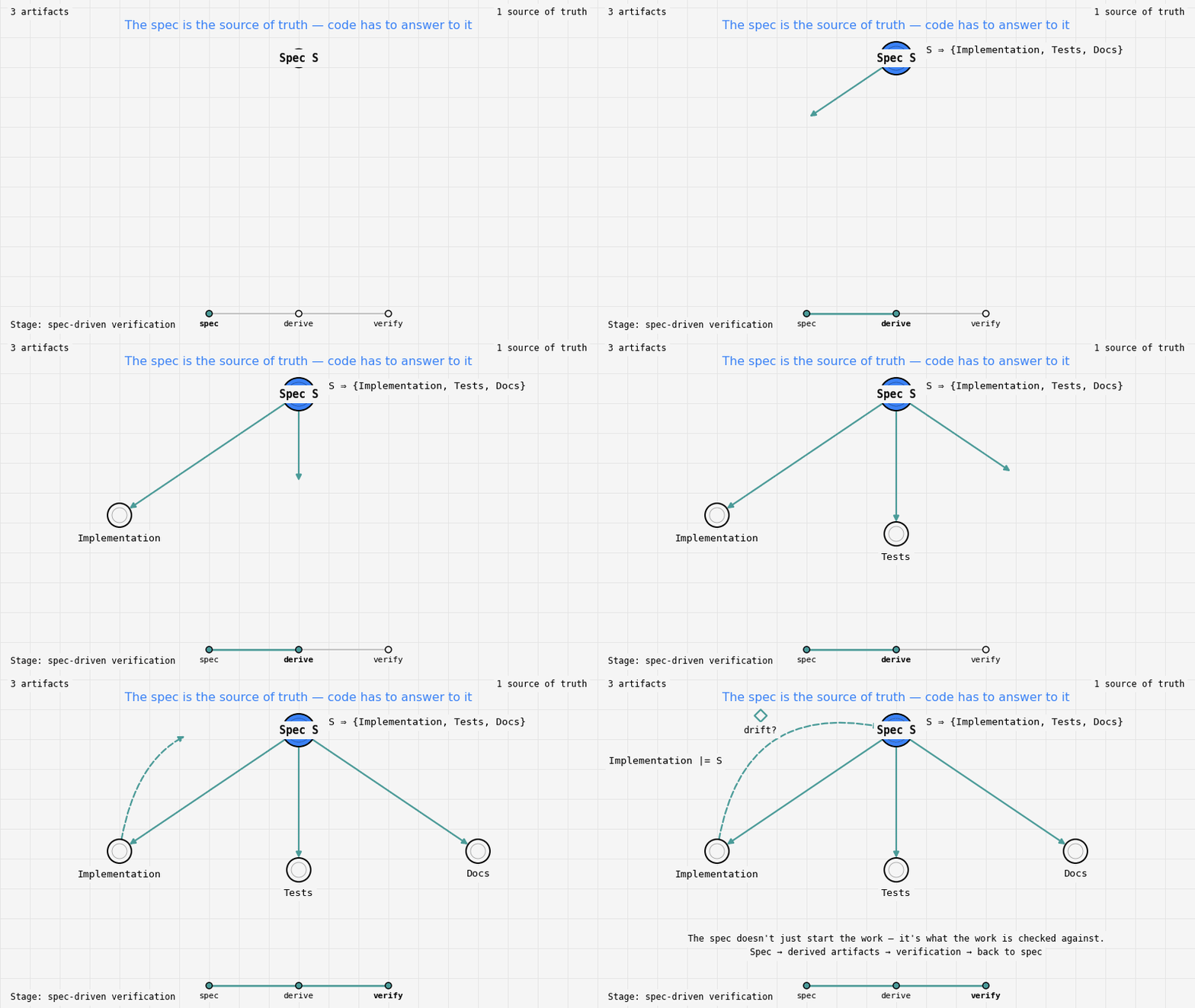
I’ll use Blitzy as the case study for this newsletter…
It’s an autonomous software development platform for the enterprise that turns what you want to build into a structured plan, then autonomously executes & validates it.
i.e., you provide the requirements and intent, then review key decisions.
Blitzy combines them with codebase context, creates the plan, executes the work with AI agents & validates the result.
Let’s dive in!
How Specification Guides Development
Here are 3 roles3 a specification plays in the software development lifecycle:
Spec-first: You write the specification before implementation begins, so you know what to build.
Spec-anchored: You keep the specification connected to the software after implementation so it can guide future changes.
Spec-as-source: You treat the specification as the human-edited source from which you can generate and/or regenerate downstream implementation artifacts (plans, tasks, tests).
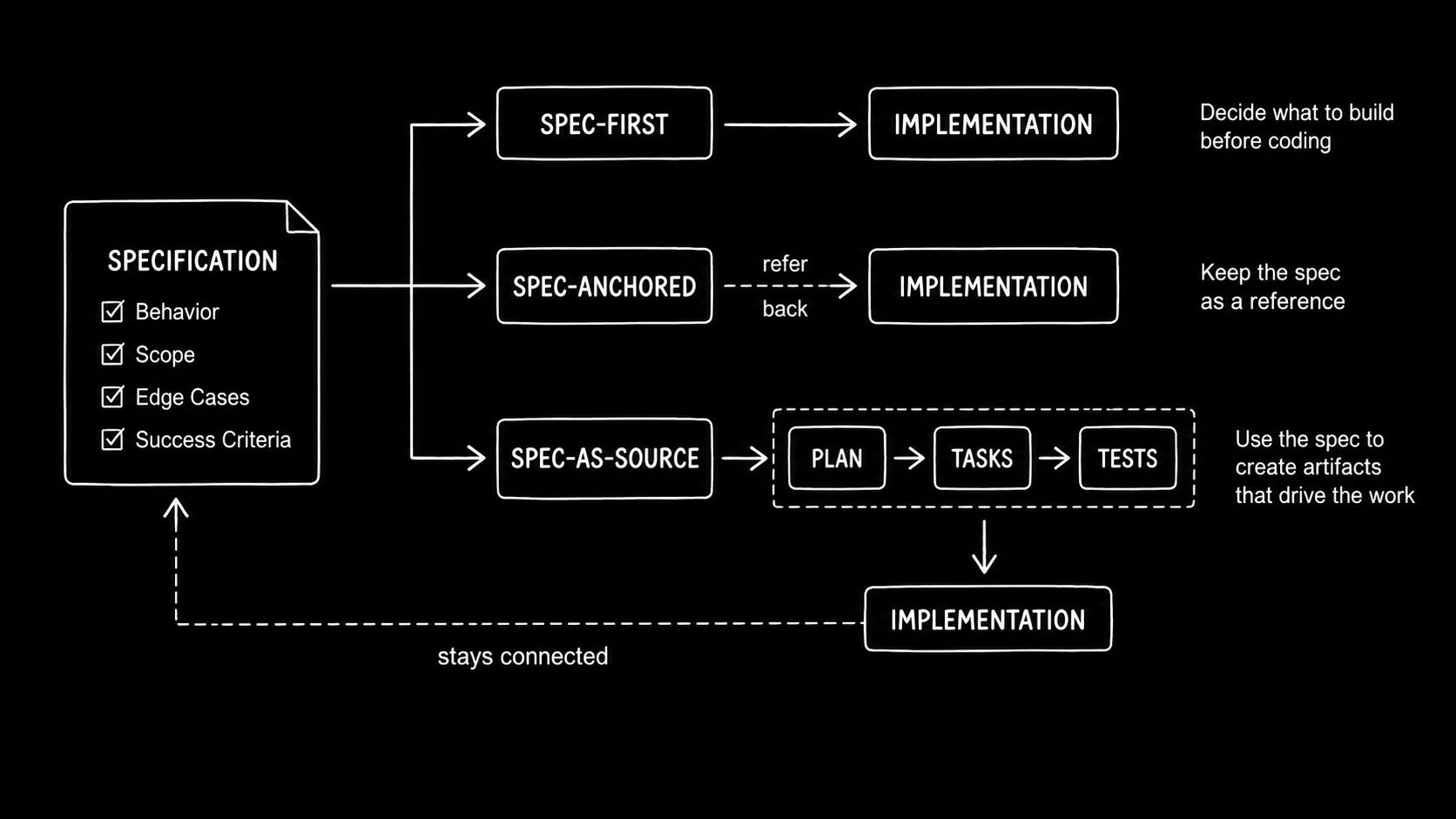
Now let’s see how SDD4 applies to our notification system…
You want to move task notifications to a new notification system. The request defines the goal, but the expected behavior still needs to be explicit.
So you define a specification:
Objective: Move task notifications to a new system.
Scope: Move task-assignment & task comment notifications. But leave billing notifications unchanged.
Requirements: Preserve existing notification preferences & delivery timing. And continue using the existing email service.
Expected behavior: Check the user’s preferences before sending notifications. If email is enabled, queue an email through the new delivery path.
Edge cases: Define what happens if delivery fails/assignee no longer belongs to the project.
Acceptance criteria: Task notifications use the new system while existing user preferences continue to work correctly.
Blitzy combines these requirements with its understanding5 of the application across repositories.
Then it uses requirements & codebase context to create an Agent Action Plan (AAP6).
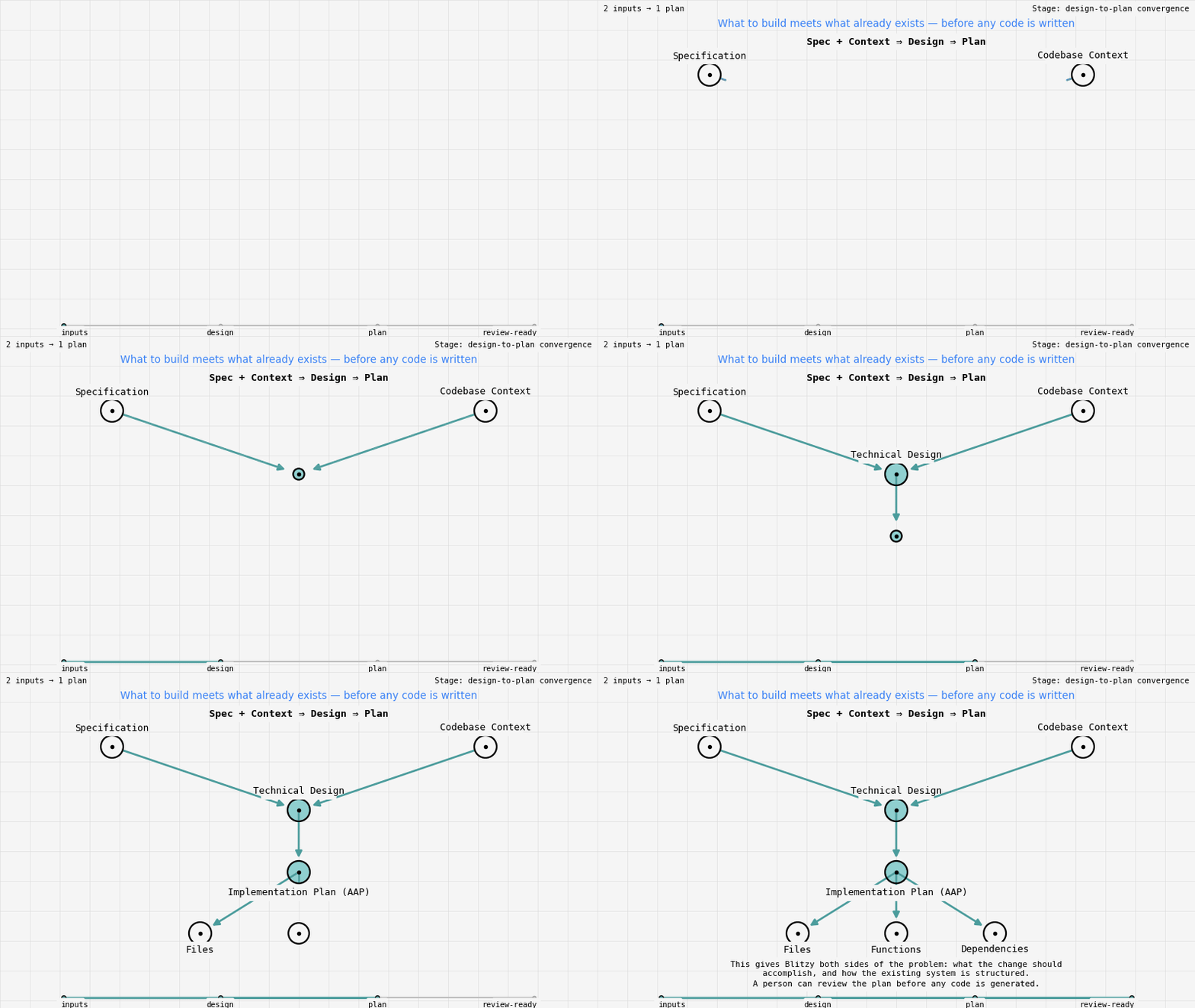
(We’ll learn how AAP works later…)
Project Rules vs Generation Prompts
A specification defines the change itself.
Yet agents need project-level instructions7 on how to do the work…
Blitzy separates these concerns through Rules & Generation prompts:
Rules: Project-wide instructions that apply whenever the agent works on the codebase, such as code style, testing & security requirements.
Generation prompt: Instructions for a specific change, such as its objective, scope, constraints, technical requirements & success criteria.

Here’s an example8:
Rule:
Every new piece of business logic must include tests.

Generation prompt:
Move task notifications to the new system while preserving
existing notification behavior and user preferences.
Requirements Clarification
A BAD assumption gets exponentially expensive the further it travels…
An unclear requirement is easier to fix while the specification is still being edited. Otherwise, the agent would fill those gaps with “assumptions” and carry them into the plan & implementation.
So you should look for these details:
Who will use the feature,
How system should handle failures,
What falls inside & outside the scope,
Which existing services should change,
What must remain backward compatible.
This lets you separate unknowns from assumptions:
Unknown: You’re missing information to make a decision.
Assumption: You make a guess because information is missing.
Here’s a simple clarification process for you to follow:
Draft the specification.
Identify missing/ambiguous requirements.
Resolve & update the specification.
Review the updated specification.
This process gives the agent clear requirements before it creates the implementation plan…
§
§
1. Understand the Existing System
The agent must first understand how the existing system works…
i.e., it needs the correct “system context9”.
This is where Blitzy’s Dynamic Knowledge Graph becomes helpful.
It gives agents a global, dynamic understanding of the application across repositories… this includes architecture, dependencies & code relationships.
Here’s how it works:
Full System Context
Imagine the specification says:
Task assignment should generate an in-app notification
for the assignee, unless the user has disabled that
notification type in their preferences.
So the agent needs to find:
Which components generate notifications
Where the system stores user preferences
Where the system handles task assignments
What depends on the current notification flow
Which services & APIs connect these components
… before changing the code.
And this becomes extremely HARD in large, complex existing10 codebases with many repos. Relevant logic could span services, background jobs, event listeners, feature flags, data models & outdated documentation.
A larger context window is NOT enough… AI agent needs to identify & retrieve parts of the codebase relevant to the requested change.
Here’s how Blitzy builds system-level understanding to solve this problem:
Analyze codebase: Blitzy analyzes code across multiple repositories to identify architecture, code patterns, terminology & dependencies. (You can also exclude files & directories with
.blitzyignore.)Build a dynamic knowledge graph: Blitzy maps relationships across the codebase (relationships that span repos), including control flow, call graphs, inheritance hierarchies & module dependencies.
Generate a Technical Specification11: Blitzy creates a current view of the codebase. This includes its architecture, dependencies, patterns & domain terminology.
The result is a global, dynamic understanding of the application that Blitzy’s agents can reference when planning, executing & validating changes…
Code Relationships
Retrieval-Augmented Generation (RAG) retrieves relevant information & adds it to the model’s context.
In a codebase, finding relevant files & components is useful, but the agent also needs to understand how they connect!..
Consider the notification system that sends an email when someone gets assigned a task… Retrieval would find12:
PreferencesTaskAssignmentNotificationService
You could represent their relationships using a dynamic knowledge graph13:
Dynamic Knowledge graph14 maps code components & relationships such as calls, dependencies, inheritance, and control flow.
Let’s look at how GraphRAG uses these relationships to retrieve context…
Graph Retrieval-Augmented Generation
“Relationships” become extremely useful when a single change affects several parts of the codebase.
Graph Retrieval-Augmented Generation (GraphRAG) uses a graph to retrieve context based on the relationships between pieces of information.
A traditional RAG would retrieve the relevant components…Each of them relevant on its own…
But graph-based retrieval shows “how they connect”.
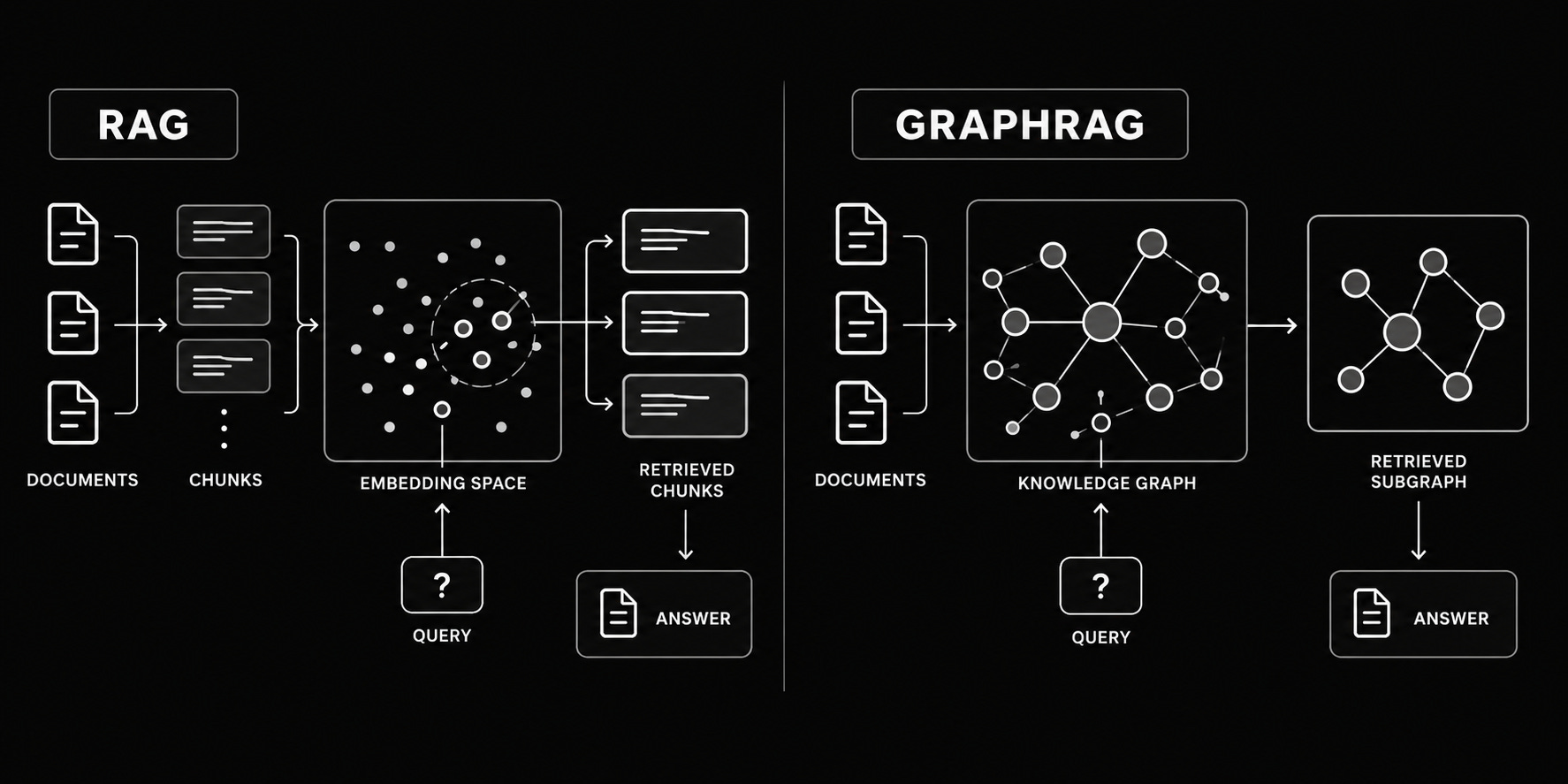
If the agent needs to change what happens when “someone gets assigned a task”, the graph could help it understand15:
What data it involves
Which components call each other
Which events flow through the system
Which downstream components it affects
In an enterprise codebase with thousands of files across many repositories, finding these connections one file at a time is extremely HARD…
A graph gives the agent a simpler way to navigate the codebase & retrieve the context16 it needs.
Change Impact Analysis
Finding the correct code is only one part of the problem…
The agent must also understand the impact17 of changing it.

Blitzy’s agents traverse Blitzy’s Dynamic Knowledge Graph in 2 directions:
Forward traversal18: Starts from a function/component & follows the call graph outward to understand what happens downstream.
Reverse traversal19: Moves backward through the graph to find which parts of the system call depend on a function/component.
If the agent needs to change NotificationService, it can traverse forward to see what NotificationService calls and backward to see what calls/depends on NotificationService.

The key is understanding how the pieces connect, NOT just what exists.
§
§
2. Build the Right Change
The AI agent now needs to determine how to make the changes correctly...
i.e., it needs an “implementation plan”.
Ready for the best part?
Agent Action Plan
One BIG change can be broken into tiny tasks & dependencies.
For notification system migration:
Update the data model,
Update the delivery flow,
Integrate with task events,
… and so on.
Blitzy handles this with an Agent Action Plan20 (AAP).
It uses the generation request & global codebase context from its Dynamic Knowledge Graph to construct the AAP. The Dynamic Knowledge Graph helps map dependencies & analyze the impact of the proposed change before execution begins.
Blitzy then algorithmically sequences the work from the AAP based on those dependencies. This helps agents execute the required work in a “logical order”.
You can then review & edit AAP before code generation begins.
This provides a checkpoint to catch incorrect assumptions, missing dependencies, and/or unnecessary changes before they become code.
Scope and Blast Radius
AAP defines what the agent should & should NOT change.
Blast radius describes which parts of the system a change/failure would affect. For example, changing NotificationService could affect every component that depends on it.
The specification can set scope boundaries21 for:
Services,
Infrastructure,
Files & directories,
Components that must remain unchanged.
Blitzy supports these boundaries through generation requests & repository exclusions.

This helps keep the implementation within its intended scope…
How Blitzy Agents Execute the Plan
Once AAP is approved, Blitzy’s agents execute the planned work…
For a BIG change, Blitzy uses AAP to sequence work based on “task dependencies”.
Then independent tasks run in parallel, while dependent tasks wait until their prerequisites finish…
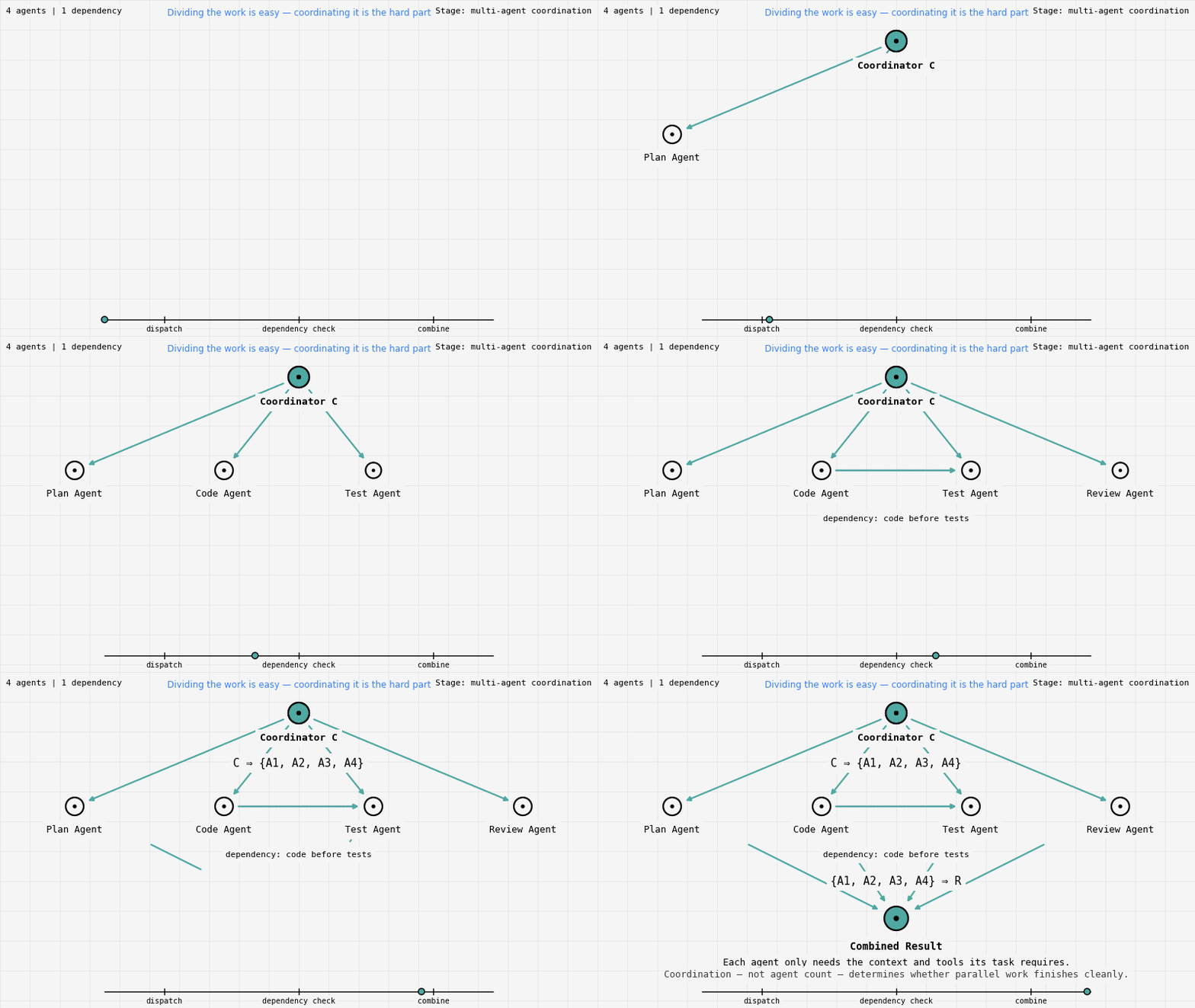
Each agent needs the context & tools relevant to its task.
Also, agents need to stay aligned with requirements & codebase context so their changes work together across repositories.
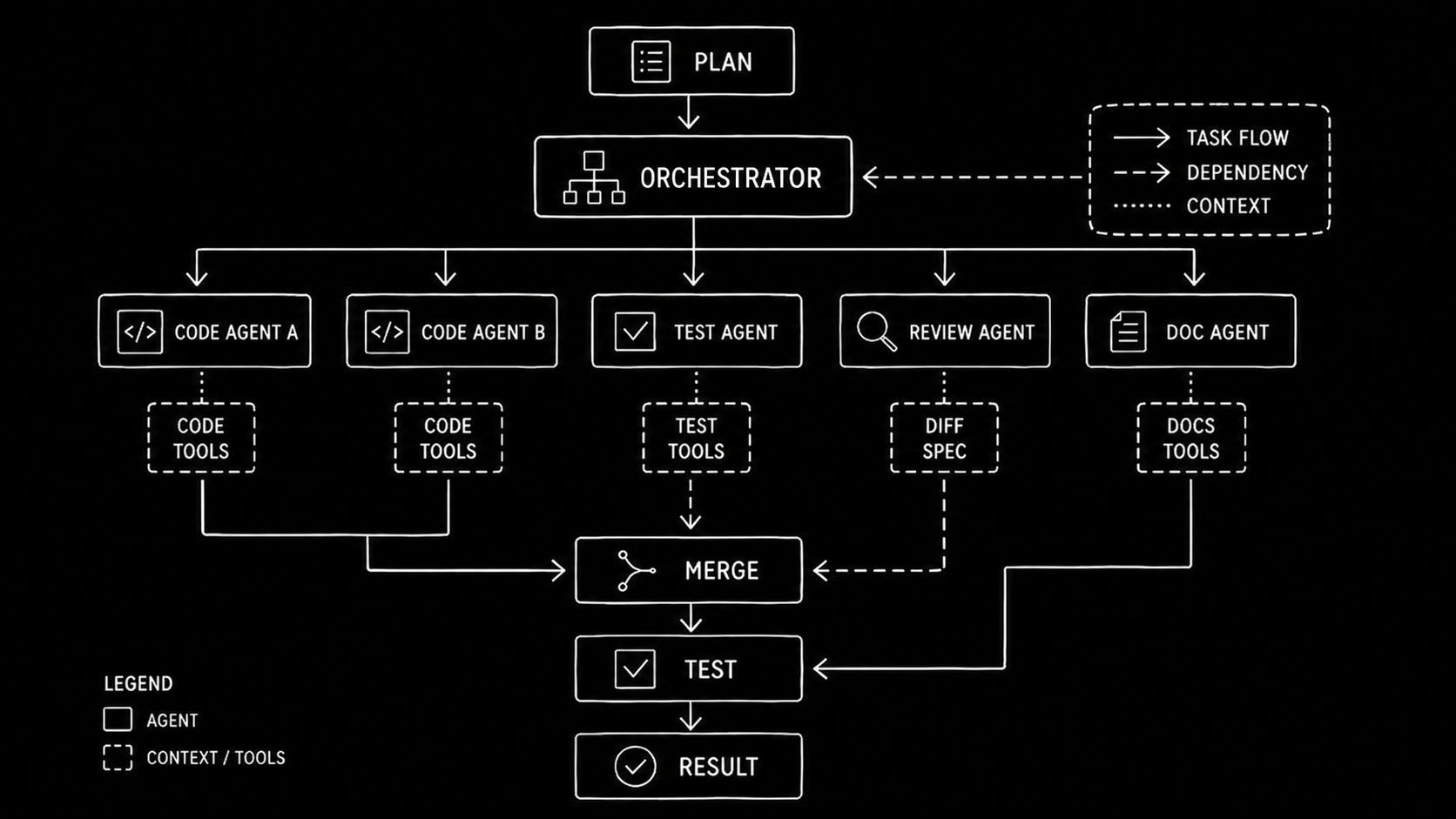
Blitzy’s orchestration layer coordinates22 specialized agents across architecture, implementation, testing, debugging, validation & integration.
The resulting changes then get combined & checked as a complete implementation23.
Verification and Validation
AI agent can implement the plan, pass tests, but still miss a “requirement.”
So the result needs to be checked against technical requirements & intended use:
Verification: Check if implementation conforms to its defined requirements.
Validation: Check if resulting software satisfies its intended use & user needs.
Testing can occur at different levels:
Unit tests: Check individual components.
Integration tests: Check whether components work together.
End-to-end tests: Check complete workflows.
Acceptance tests: Check whether software meets defined requirements & user/business needs.
But automated tests only catch behaviors they actually check…
An extra review is needed to identify missing requirements and/or problems outside test coverage…
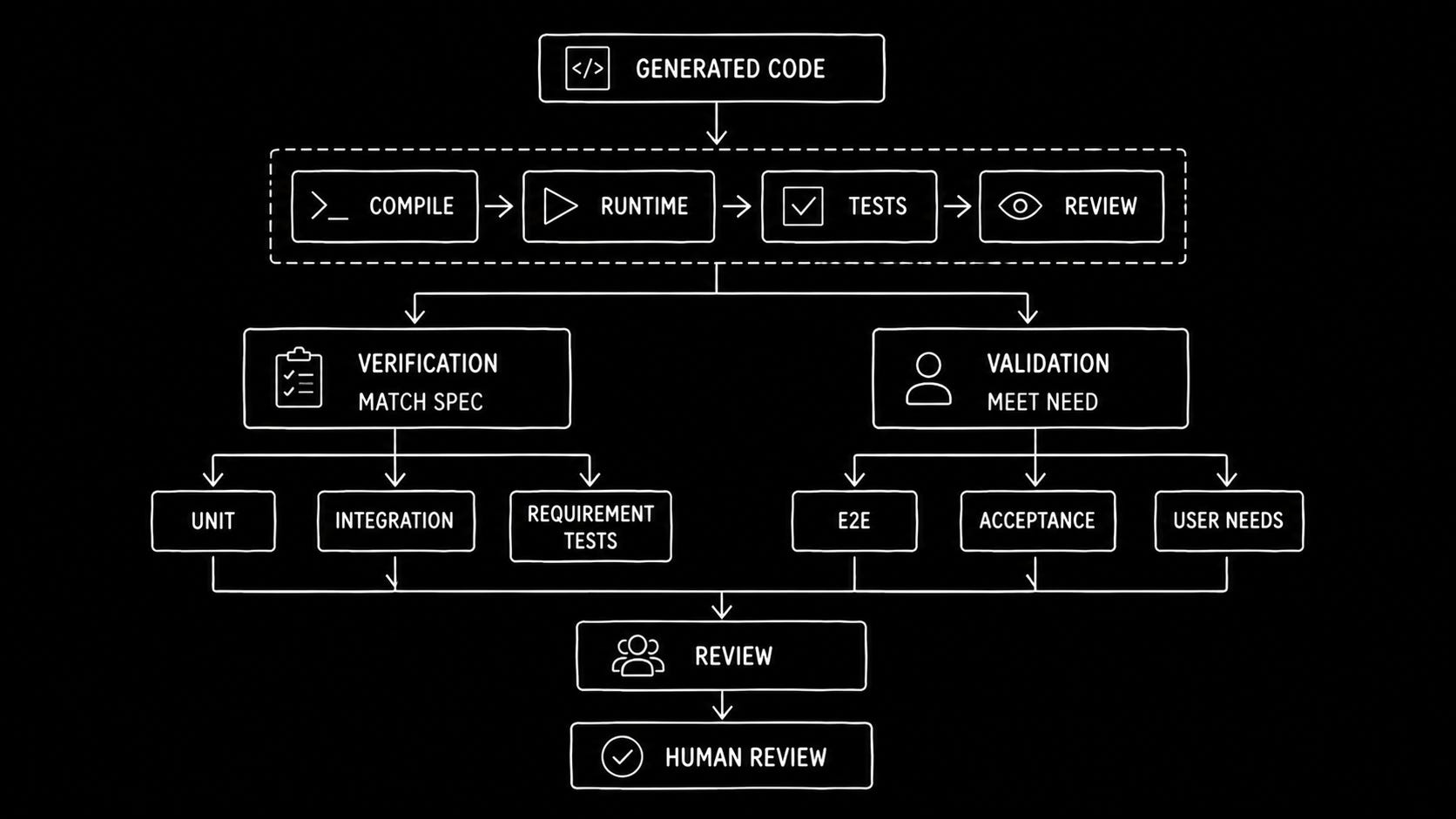
Blitzy combines human oversight with automated validation throughout the development process:
AAP review24: You review implementation plan before code generation begins.
Automated validation25: Blitzy checks generated code using signals such as builds, tests, benchmarks & CI checks26.
Project Guide & code review: Blitzy generates a Project Guide27 with each pull request. This shows what got built, which requirements were addressed, and what work remains. PR Review then organizes changes into logical groups, explains why Blitzy made each change alongside the diff & surfaces relevant testing and QA results. This helps you review what changed, why it changed & how it was validated before deciding whether to merge.
i.e., passing tests alone is NOT enough…
The final implementation should be reviewed against the original requirements, scope & expected behavior.
Drift Check
As agents implement changes, code can drift from the original specification…
Blitzy prevents this drift during execution by orchestrating spec-adherence agents that continuously check generated work against approved requirements. It validates outputs at multiple levels, from individual files through end-to-end testing.
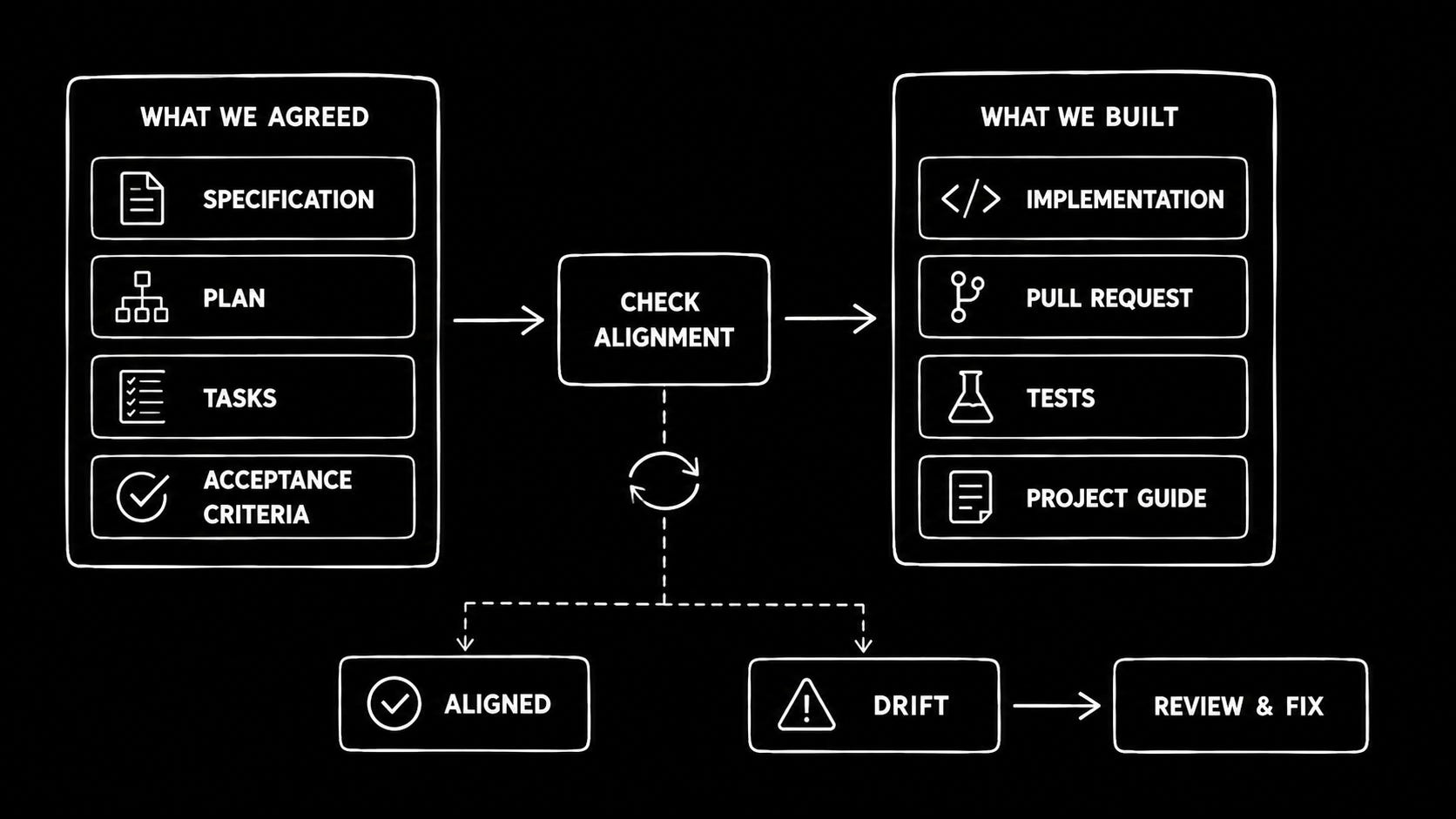
This approach helps to find:
Incomplete work,
Missing requirements,
Changes outside agreed scope,
Remaining work that needs attention.
You make the final merge decision.
You review & test the generated changes, identify remaining gaps, and decide whether to merge the pull request or request extra changes.
§
§
3. Autonomous Work
As AI agents take on more work autonomously, you need to control what they can access, what actions they can take & when humans should step in.
Onward.
Security and Governance
Start with permissions:
Repository access: Limit which code agent can access.
Tool access: Limit which tools & operations it can use.
Network access: Limit which external systems it can reach.
Least privilege: Give AI agent only the permissions required for its task.
The agent also needs to distinguish trusted instructions from retrieved content…
Code, comments & documentation can contain instruction-like text. So treat retrieved content as data, and NOT trusted instructions. This reduces prompt injection28 risk.
Plus controls must continue after deployment29… Monitoring helps detect unexpected behavior that only appears in production.
Blitzy applies several enterprise controls across its development workflow:
Data security: Customer data is encrypted in transit & at rest. Customer code is not used for model training/stored directly.
Isolated execution: Code generation runs in an air-gapped environment with an inbound-only VPC architecture30.
Deployment options: Blitzy supports cloud, VPC, black-box VPC, on-premises & black-box on-premises deployments.
Human review: You review the Technical Specification, approve the AAP before code generation & review generated changes before merge.
QA: Multiple QA agents review generated work before delivery. Customers perform their own QA & security testing before deployment.
Compliance: Blitzy maintains SOC 2 Type II compliance & ISO 27001 certification31.
These controls put boundaries around what autonomous agents can access, execute & ship…
Human Oversight
Human oversight defines when people need to review/intervene.
Here are two popular approaches:
Human-in-the-loop: A person must participate at specific decision points before the agent can continue.
Human-on-the-loop: The agent operates more autonomously while a person supervises the process & intervenes if necessary.
A development workflow can use both…
You review specifications, approve the plan, review security-sensitive changes, & make the final release decision.
Blitzy uses human review at key stages:
Its Agent Action Plan creates a review point before code generation.
After generation, automated checks use tests, benchmarks, builds, and other signals to assess the result.
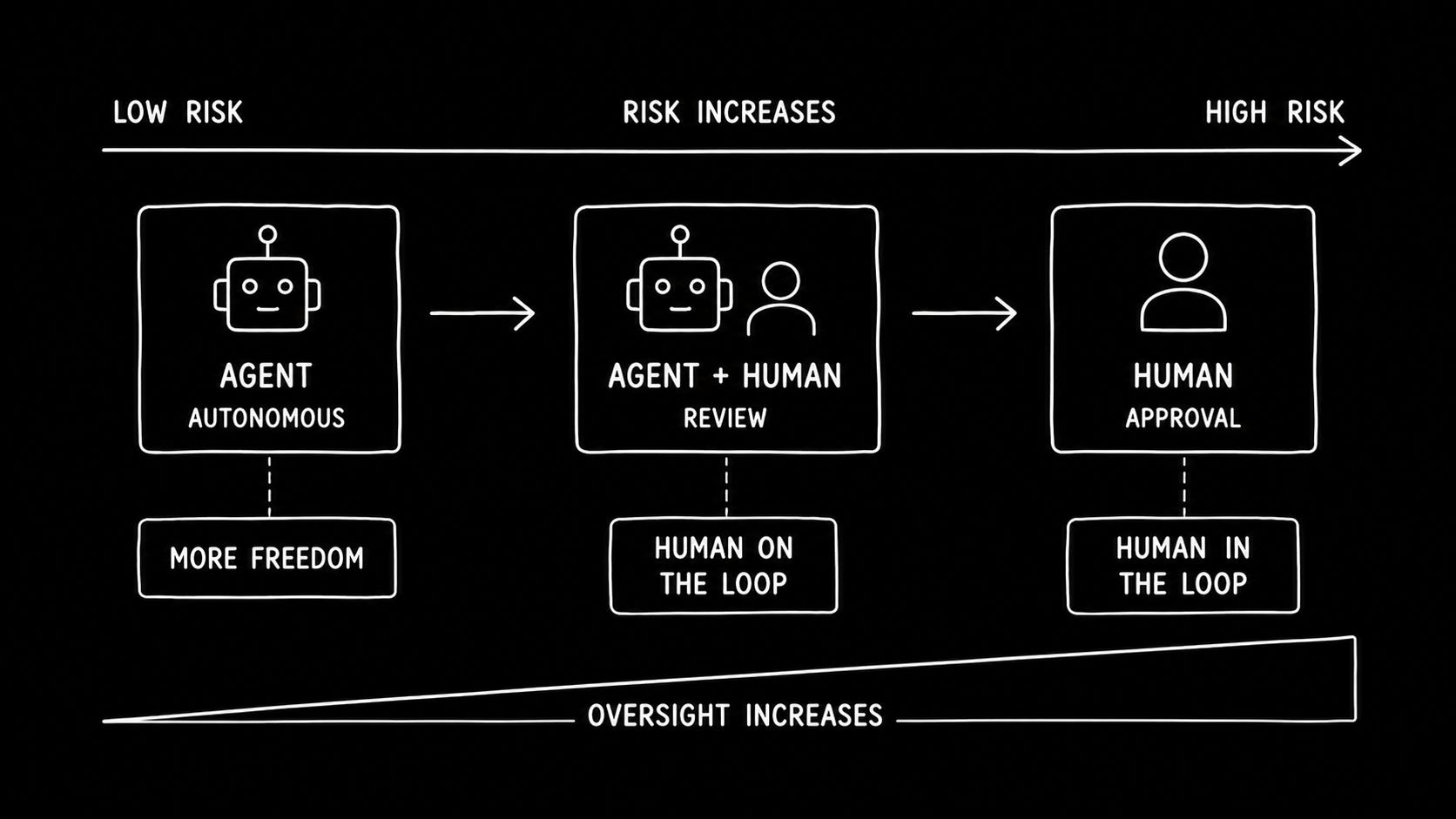
Yet some changes need closer review because mistakes can have massive consequences:
External system integrations
Data persistence & migrations
Regulatory/contractual business logic
Authentication & session management
These areas benefit from review by engineers, architects and/or domain experts who understand the relevant system & requirements.
§
Blitzy SDD Workflow
You’ve now seen the key parts of the SDD workflow.
But how does Blitzy bring them together into one development process?
Here’s how:
Codebase Onboarding: Blitzy analyzes the existing codebase across multiple repositories & builds a dynamic Knowledge Graph of its architecture, dependencies & relationships.
Technical Specification: Blitzy generates a living Technical Specification to give you a view of its understanding of the existing codebase across repositories.
Requirements: You write a generation prompt to describe what you want to build/change in Blitzy’s Workspace. You define the objective, scope, technical requirements, constraints & success criteria & attach supporting files when needed.
Agent Action Plan: Blitzy combines the generation request with global codebase context to create an AAP. This defines the implementation approach, scope, dependencies & required code changes.
Plan review: You review, edit & approve AAP before code generation.
Multi-agent execution: Blitzy orchestrates specialized AI agents across different models to implement the plan. The agents work on different parts of the project.
Validation: Blitzy orchestrates spec-adherence agents during execution & validates outputs at multiple levels, from individual files through end-to-end testing.
Review handoff: Blitzy delivers the generated changes with a Project Guide that explains what was built & what work remains.
Human review: You review the results, perform any remaining tasks based on the next step guide & decide whether the pull request reaches production.
Thus the requirements remain connected to the implementation throughout the workflow… and help to prevent the original intent from getting lost…
§
Final Thoughts
Blitzy shows what an SDD workflow can enable: AI agents can take on enterprise software changes while you keep control of the outcome.
Blitzy connects these steps through codebase understanding, Agent Action Plans, multi-agent execution, validation & review.
You can reuse these ideas to build AI agents…
But implementing them at enterprise scale is hard. This is why I loved using Blitzy32, and you should try it too.
Eligible organizations can try Blitzy at no cost with up to 1M lines of code reverse-engineered, 25K lines of code forward-engineered, and built-in Proactive Insights to identify and prioritize risks across the software estate.
Thank you for reading.
– Neo
If you find this newsletter valuable, share it with a friend and subscribe if you haven’t already. There are group discounts, gift options, and referral rewards available.

Want to reach 250K+ tech professionals at scale? 📰
If your company wants to reach 250K+ tech professionals, advertise with me.
Thank you for supporting this newsletter.
You are now 250,001+ readers strong, very close to 251k. Let’s try to get 251k readers by 29 September. Consider sharing this letter with your friends and get rewards.
Y’all are the best.

References
Microsoft Research - GraphRAG: Unlocking LLM Discovery on Narrative Private Data - Microsoft
OWASP GenAI Security Project - OWASP Top 10 for LLM Applications 2025 - OWASP
OWASP GenAI Security Project - OWASP Top 10 for Agentic Applications 2026 - OWASP
Blitzy - System 2 AI Platform: Topping SWE-Bench Verified - Blitzy
Blitzy - Blitzy Scores a Record 84.95% on SWE-Bench Pro - Blitzy Blog
YouTube - How Agentic SDLC Turned a 5-Month Project Into 5 Days with Brian Elliott and Tom Jackson
Blitzy - Taking the Long and Less-Traveled Road Is the Only Path to Autonomy - Blitzy Blog
Blitzy - Hello World! The Blitzy C Compiler Has Arrived - Blitzy Blog
Blitzy - A Quick Blitzy Chat: 3 Codebases Take on Prompting - Blitzy Blog
An AI agent is a software system that uses an AI model to decide what actions to take, use tools & execute multi-step tasks toward a goal.
Tool: An external capability an AI agent can call to retrieve information or perform an action.
Think of ordering a burger at a restaurant:
Spec-first: You place your order before the kitchen starts cooking.
Spec-anchored: Your order remains the reference as the meal is prepared, and if the order changes.
Spec-as-source: You change the order itself, and the kitchen uses the updated order to produce the meal again.
What SDD Still Hasn’t Solved
SDD gives engineering teams a structured way to move from requirements to implementation, but some practical questions remain:
How much autonomy should an agent have? A reversible, low-risk change may need less oversight. A change to a critical system may require tighter limits and more human review.
How do specifications stay aligned with code? If the implementation changes, the specification needs to change with it. When they disagree, someone still has to decide which one reflects the intended behavior.
How do you provide the right context? The information an agent needs can vary significantly from one task to another. Teams need reliable ways to provide and maintain that context.
How do you know SDD is working? Possible measures include correctness, development time, rework, defects, and human review effort. The challenge is deciding which ones matter for a particular team.
Who owns all of this? SDD adds work beyond writing code. Specifications, system context, validation, and governance must be maintained alongside implementation. How teams divide those responsibilities will shape how SDD works in practice.
The specification defines the behavior you want, but Blitzy also needs to understand the codebase it will change…
For an existing codebase, Blitzy first ingests the code & builds a structured representation of its architecture, dependencies, and existing behavior. It also produces a living Technical Specification that gives you a reviewable view of its understanding of the system.
When you submit your requirements, Blitzy analyzes them against this codebase context.
Agent Action Plan (AAP) is Blitzy’s implementation blueprint that defines the code changes, dependencies, design decisions, and scope agents will follow during code generation.
Project-level instructions are reusable rules that apply across the project, rather than requirements for one specific feature.
For notification migration, the generation prompt could define which task events create notifications, who receives them, which channels deliver them, and how the existing notification flow should behave during the migration.
Shows how the existing codebase works & where the change fits.
Brownfield development: the agent is working within an existing system rather than starting from scratch. You point an AI agent at your application’s repository (or repos).
Blitzy uses this context to provide a queryable view of the codebase’s architecture, dependencies, patterns, and conventions.
TaskAssignment triggers an event. Another component handles the event and calls NotificationService. That service triggers EmailWorker, which checks Preferences before sending the email.
A knowledge graph represents both:
What exists
How those things connect
This gives the AI agent something closer to a map of the codebase than a list of files.
This helps the agent understand the impact of a change: If it changes TaskAssignment, it can find which downstream components might be affected.
Relevant components and the relationships between them.
A component can be relevant because it calls the code being changed, consumes an event it produces, shares the same data model, or relies on its current behavior. Finding these relationships means understanding how different parts of the codebase connect, not simply reading more files.
Blitzy describes this as following an execution thread forward from a seed function.
Blitzy describes this as useful for impact analysis.
Agent Action Plan (AAP) is Blitzy’s implementation plan for a development task.
It defines how Blitzy’s agents will implement the requested change, including relevant code changes, files, dependencies, design decisions, and scope.
Generation request = what you want changed
AAP = how Blitzy plans to make that change
The specification can define what the agent can change & what must remain untouched.
The orchestration layer can dynamically plan, spawn, and coordinate specialized agents, while parallelizing the Agent Action Plan into workstreams covering architecture, implementation, testing, debugging, validation, and integration.
Real-World Example: BCC
Blitzy built BCC, a Rust-based C compiler, with 229,983 lines of Rust across 129 source files and 14 SIMD headers. The project coordinated 3,600+ agents across 127 files and produced 2,271 passing tests.
The example shows Blitzy’s multi-agent approach at project scale: agents work across different parts of the codebase, and testing validates the combined implementation.
AAP review: Before code generation, you review the plan for requirement coverage, scope, dependencies, design decisions, edge cases, and expected changes. An incomplete AAP can lead to incomplete code.
Build & test: After code generation, you build & test changes to verify the implementation behaves as described, rather than only checking whether the code compiles.
CI checks: Automated Continuous Integration checks that verify code changes build, pass tests & meet quality rules before they’re merged.
The Project Guide makes this comparison more structured.
Prompt injection: Malicious or untrusted content that tries to manipulate an AI agent into following unintended instructions.
NIST describes post-deployment monitoring as important for checking whether AI systems continue to operate as expected and for identifying unforeseen outputs and consequences.
Inbound-only Virtual Private Cloud (VPC) architecture: Your system can receive approved incoming connections, but it cannot freely connect out to the internet or external systems.
SOC 2 Type II compliance: Shows a company’s security controls have been independently audited and found to operate effectively over a period of time.
International Organization for Standardization (ISO) 27001 certification: Shows a company follows an independently audited standard for managing information security.
Thanks to Blitzy for partnering on this newsletter and sharing highly valuable information.