

If you want to achieve 99.99% uptime, read this:

Building reliable software starts with reliable infrastructure.
Synteq is a cloud compute provider built for high availability, with a 99.99% uptime target and its own data centers, racks, hardware, and network.
Here’s what you get:
High availability: VPS, bare metal, and GPU cloud designed to keep workloads running.
Predictable pricing: Flat monthly bills with no unexpected egress charges.
Fast deployment: Deploy in minutes using the portal or CLI.
Expert support: Get help directly from engineers, not ticket triage.
If you’re designing systems to survive failures, run them on infrastructure built with availability in mind.
CLAIM YOUR FREE MONTH ON SYNTEQ →
Exclusive to readers of this newsletter: Get your first month FREE!
(Thanks to Synteq for partnering on this newsletter.)
Now let's review some of the key microservices concepts & popular questions that come up in interviews:
1. Asynchronous messaging
“When should microservices talk through a message queue and not call each other directly?”
Explanation
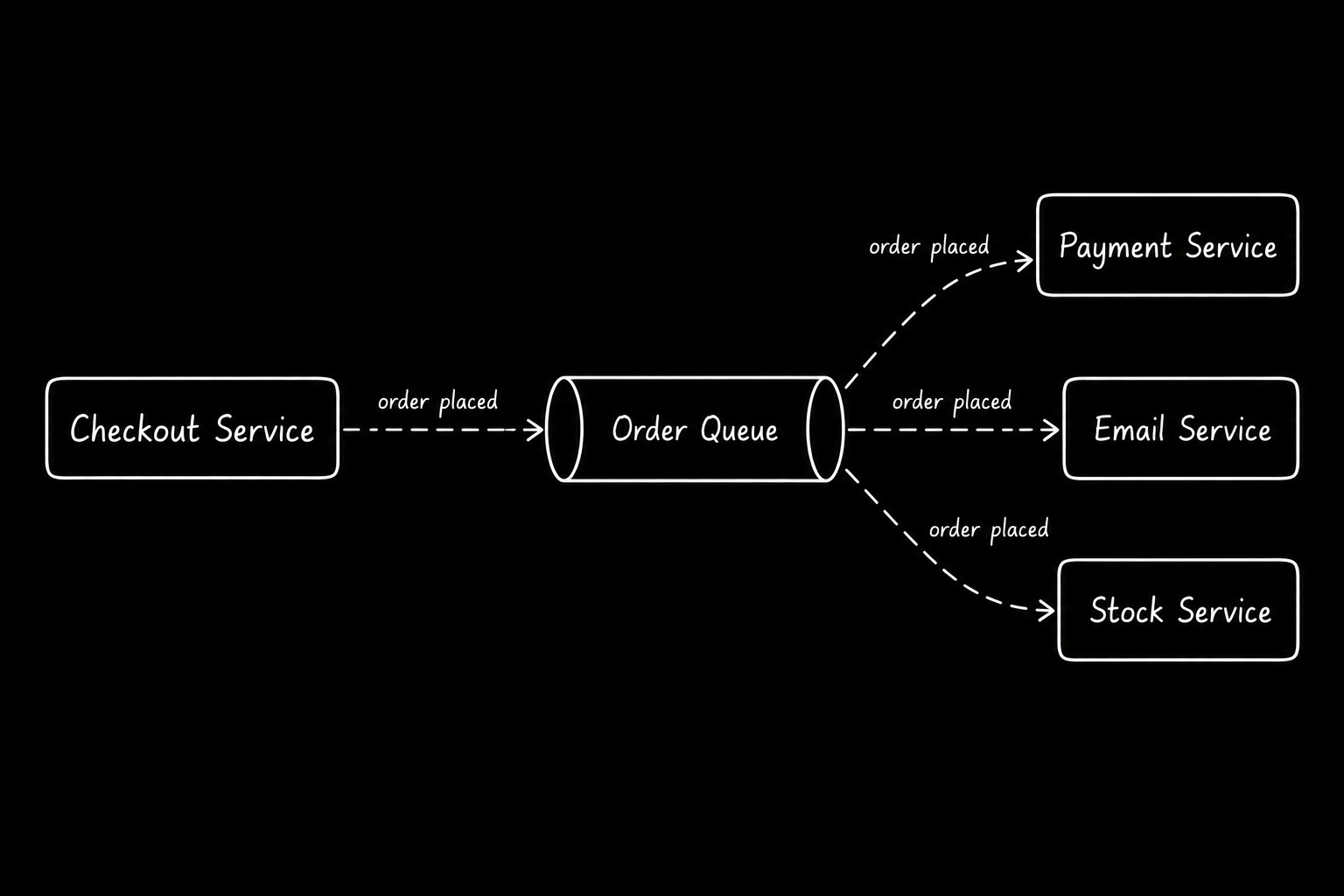
Use asynchronous messaging when the calling service doesn’t need an immediate response, when tasks take longer to complete, or when services need to handle traffic spikes independently.
For example, checkout publishes an order placed event to a message broker. Payment, email & stock services process the event at their own pace. If one service is down, its messages remain queued until it recovers.
This reduces coupling between services and allows checkout to acknowledge the order without waiting for every downstream service to finish processing.
Tips for a strong answer
Use when the caller doesn’t need an instant answer--emails or long-running jobs.
Queues absorb traffic spikes, so slow consumers could catch up later.
One event reaches many consumers through a topic.
Most brokers deliver at least once, so consumers must handle duplicates.
Send messages that keep failing to a dead-letter queue for review.
Likely follow-up
“How do you keep messages in order?”
Most brokers only keep order within one partition.
Send every message for one order to the same partition, using the order ID as the key. Consumers then process each partition one message at a time.
Common mistake
Claiming exactly-once delivery solves duplicates. Across a network, assume at-least-once delivery and make each consumer idempotent.
2. Eventual consistency
“A user updates their profile photo, refreshes the page, and still sees the old one. Is this a bug?”
Explanation
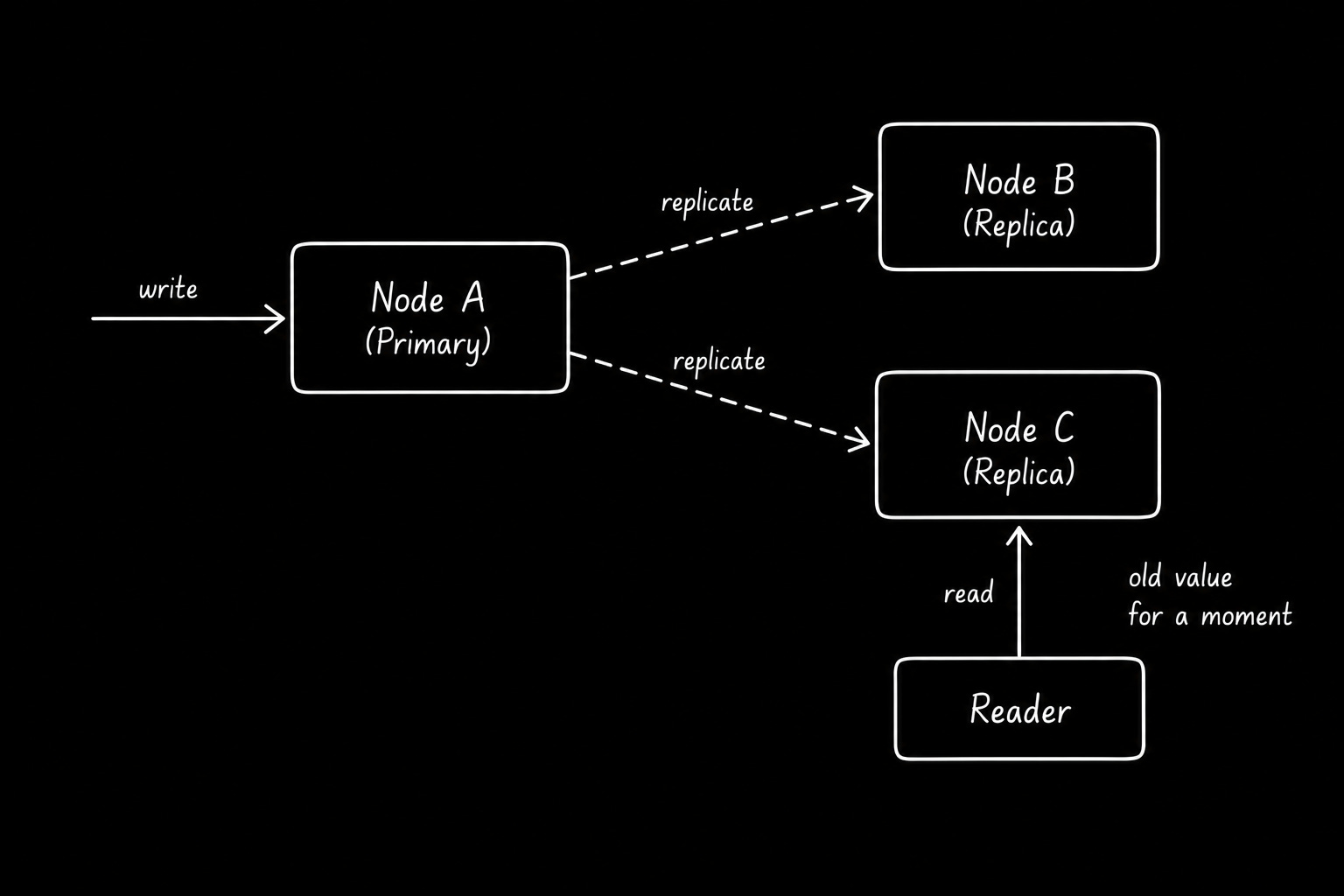
Eventual consistency = copies of data may briefly disagree, but all reach the same value once updates stop.
A write lands on one node and spreads to the others in the background. For a short time window, a read from another node may return the old value. The system stays up and fast even when some nodes can’t talk.
Within milliseconds or seconds, every copy catches up.
Tips for a strong answer
Explain the cause: write landed on one copy but the read hit another.
It’s fine for feeds, likes, and catalogs.
Fix the user’s own view with read-your-writes, such as reading from the primary for a short time after a write.
Keep strong consistency for money & stock.
Likely follow-up
“Two users edit the same record on different nodes at once. Which change wins?”
You need a conflict rule.
Last write wins is simple but can lose an update. Version numbers let you spot the conflict and reject the stale write. Some systems merge both changes automatically.
Common mistake
Treating eventual consistency as NO consistency.
Copies are guaranteed to converge. Strong candidates also say how long “eventually” takes in their system and how they’d measure it.
Share this letter & I’ll send you some rewards for the referrals.
3. Timeouts and retries with backoff
“A downstream call fails now and then. How do you make the caller more reliable?”
Explanation
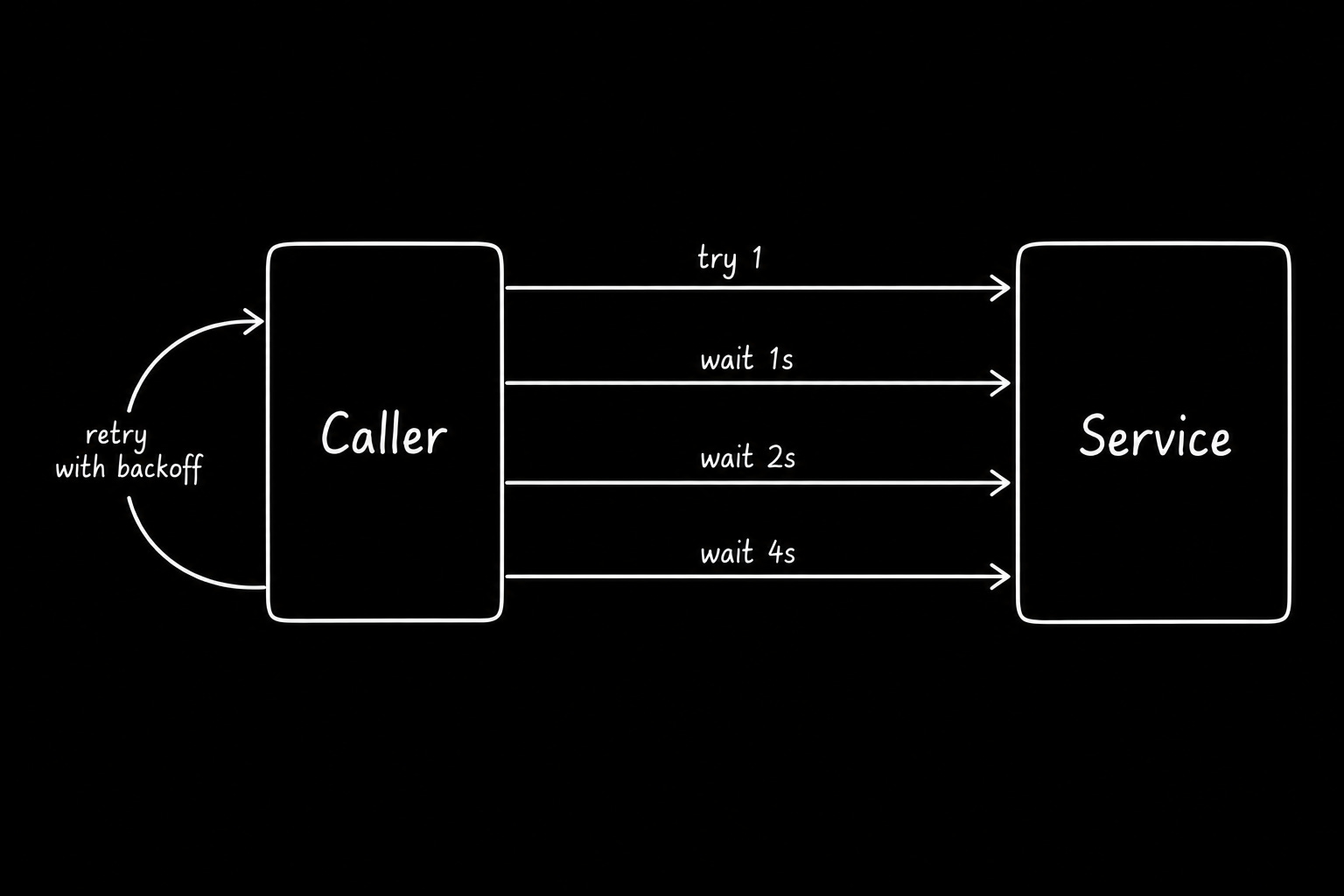
Timeouts and retries with backoff define how long a caller waits and when it retries.
A timeout ends the wait after a set time, so threads don’t pile up. A retry then repeats the call for brief failures, like a dropped packet. Backoff doubles the wait before each new attempt.
Jitter adds a random offset, so thousands of clients don’t retry at the same instant.
Tips for a strong answer
Always set a timeout slightly above the call’s normal slowest response time.
Retry only brief errors, like timeouts or a
503, never a400.Use exponential backoff with jitter1.
Cap the number of retries.
Retry only idempotent operations.
Likely follow-up
“Service A call B, B call C, and each one retries three times.
What happens when C fails?”
The retries multiply. One user request can turn into nine calls to C, and more with each extra layer. A small failure becomes a flood. Retry at one layer only, usually the outer one, and let the inner layers fail fast.
Common mistake
Retrying in a tight loop without a limit. A short outage then turns into a retry storm.
4. Remote procedure call
“When would you choose gRPC over REST?”
Explanation
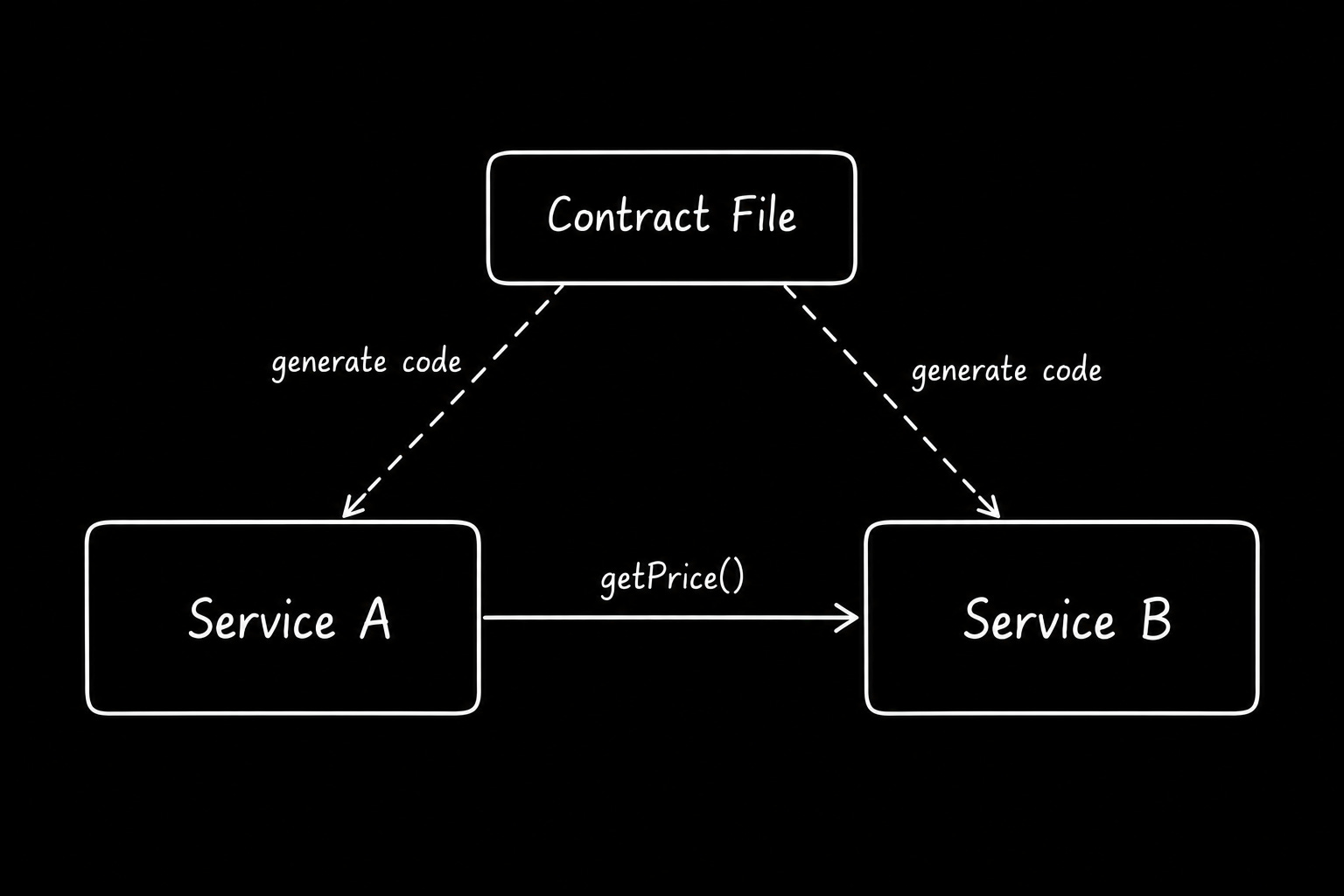
A remote procedure call (RPC) lets one service call a function on another service as if it were local.
You define the service and its messages in a contract file. A tool generates client and server code from it. gRPC2 sends compact binary messages using Protocol Buffers. It runs over HTTP/2, which carries many calls on one connection at once.
Tips for a strong answer
Choose gRPC for frequent calls between internal services.
Binary messages are smaller & faster to parse than JSON.
Typed contracts with generated code catch mismatches at build time.
HTTP/2 supports streaming in both directions.
Keep REST for public APIs & browsers, as browsers need a proxy for gRPC.
Likely follow-up
“How do you change a gRPC contract without breaking callers?”
Add new fields with new field numbers. Never reuse or change an existing number. Mark removed fields as reserved. Old clients simply ignore fields they don’t know.
Common mistake
Treating a remote call like a local one. It can timeout, fail, or run slow, so you still need timeouts & retries.
5. Distributed transaction
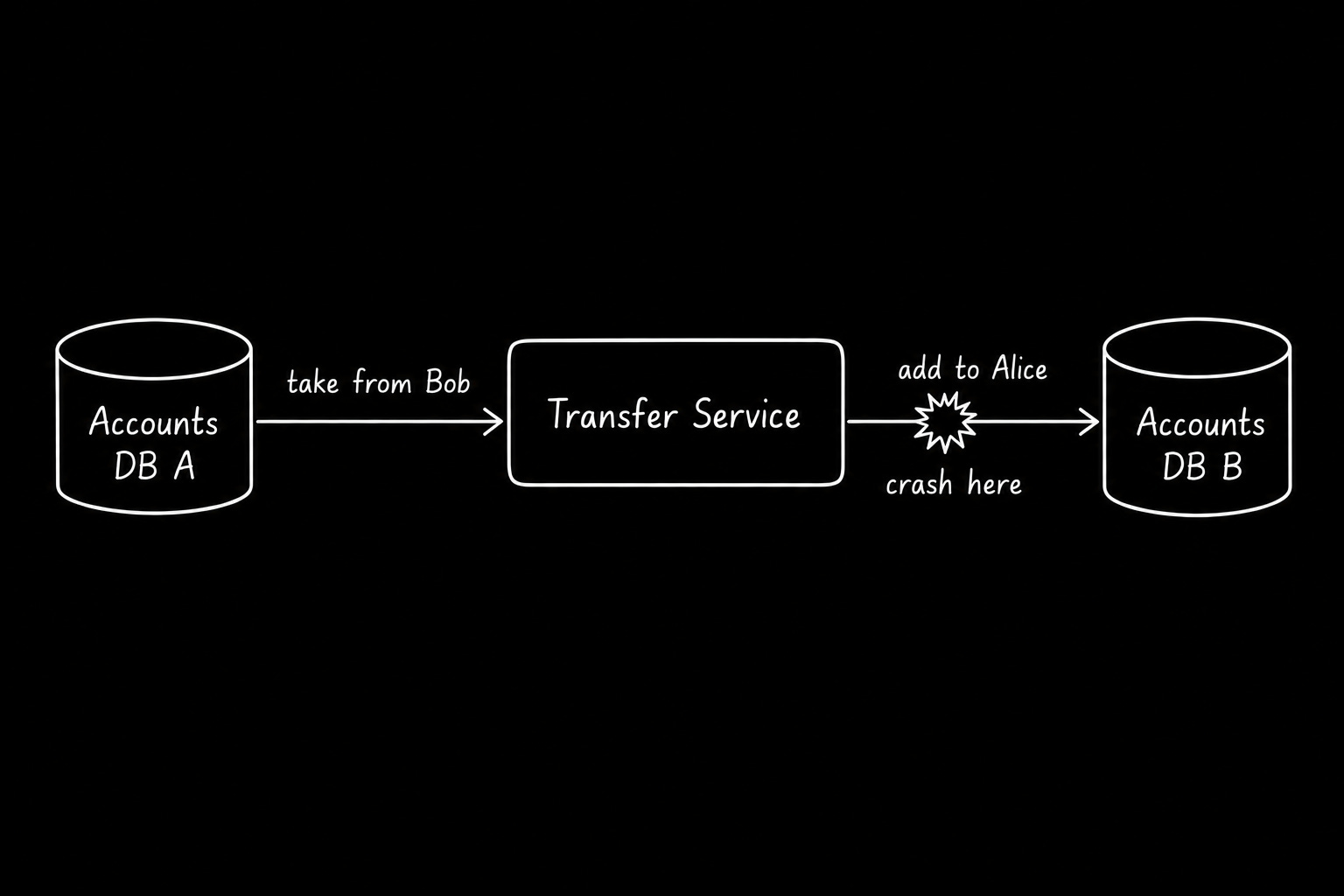
“Bob sends ten dollars to Alice. But their accounts live in different databases.
How do you keep the money correct?”
Explanation
Use a distributed transaction to coordinate the debit from Bob’s account and the credit to Alice’s account across both databases.
If one operation fails, the system must either roll back the transaction or recover through retries or compensating actions.
Patterns like two-phase commit (2PC3), Saga, and Try-Confirm-Cancel (TCC) achieve this with different consistency and availability trade-offs.
Each transfer should also have a unique transaction ID to prevent duplicate debits or credits during retries.
Tips for a strong answer
Explain the failure first: money leaves Bob’s account but never reaches Alice’s.
Name the options: two-phase commit, try-confirm-cancel, and saga.
Pick based on needs: strict consistency or availability & scale.
Ask whether the data could live in one service, which removes the problem.
Give each transfer an ID and a state, and make every step idempotent.
Likely follow-up
“Which approach would you pick for a payments system?”
A saga or try-confirm-cancel, with a durable record of each transfer.
Every step is idempotent, so retries are safe. A reconciliation job checks balances against the ledger and flags anything that doesn’t match.
Common mistake
Jumping straight to a pattern name without explaining the crash case. Interviewers want to hear what goes wrong before you fix it.
6. Independent deployability
“How do you release a change to one service without breaking services which call it?”
Explanation
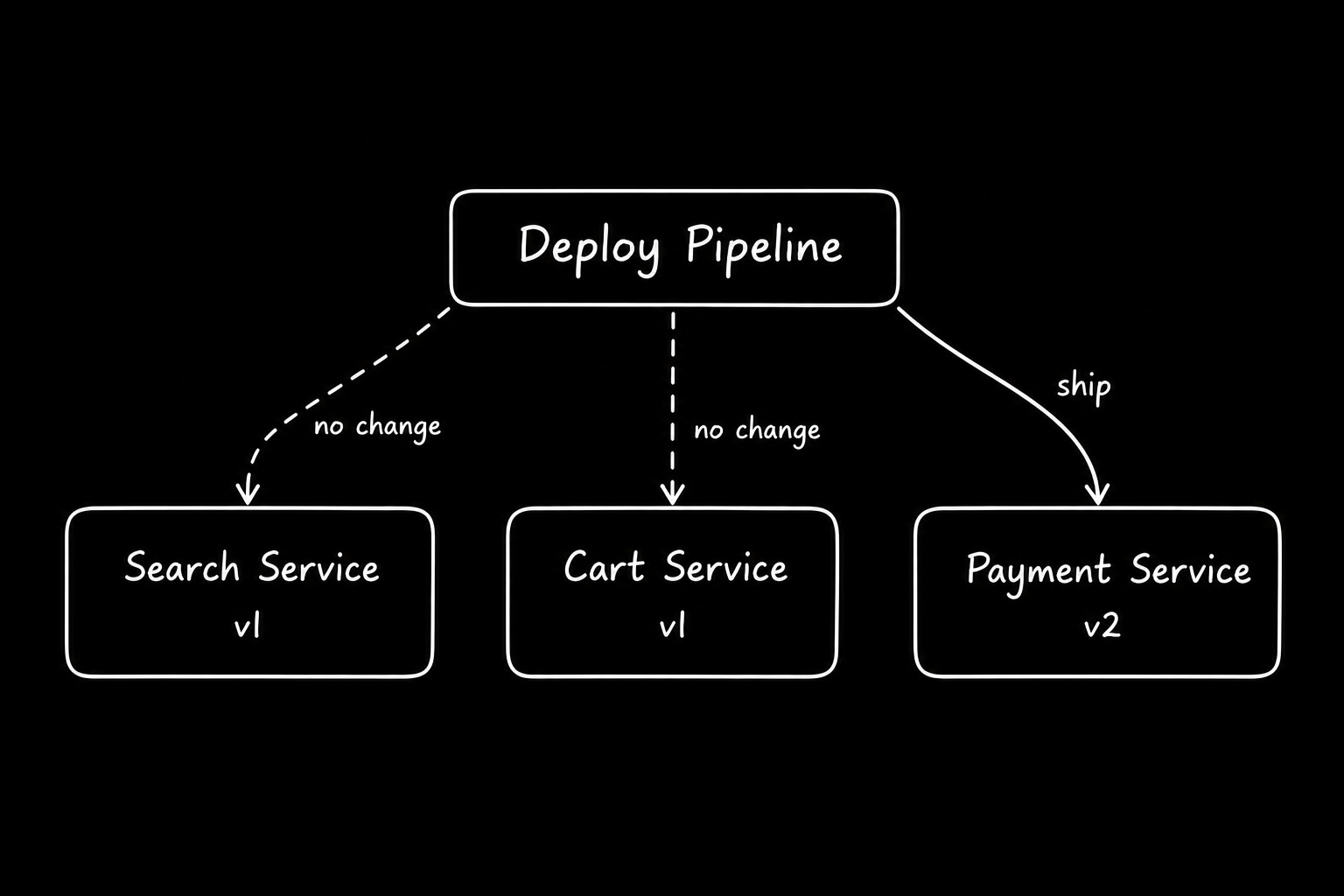
Make each service independently deployable by giving it its own build & deployment pipeline and maintaining backward-compatible API contracts.
Use contract testing4 to verify that changes don’t break existing callers. If a breaking change is unavoidable, introduce a new API version and keep the old version running until all callers migrate.
Use canary or blue-green5 deployments to release changes gradually & roll back if something goes wrong.
This allows each service to evolve and deploy independently without requiring coordinated releases.
Tips for a strong answer
Make changes backward compatible. Add fields, and never remove/rename them in one step.
Version the API when a breaking change cannot be avoided & run both versions side by side.
Run contract tests in each pipeline, so a provider can’t break what its consumers expect.
Release safely with canary or blue-green deployments and a fast rollback.
Likely follow-up
“Every caller uses a field you need to rename. How do you do it?”
Use expand and contract. Add the new field next to the old one, and return both. Move callers to the new field one at a time. Once nobody reads the old field, remove it.
Common mistake
Relying on a shared test environment and a joint release of several services. If services must ship together, you’ve built a distributed monolith. Interviewers listen for whether you know the term.
7. Backend for frontend
“Your mobile app makes 8 API calls to load one screen. How do you fix it?”
Explanation
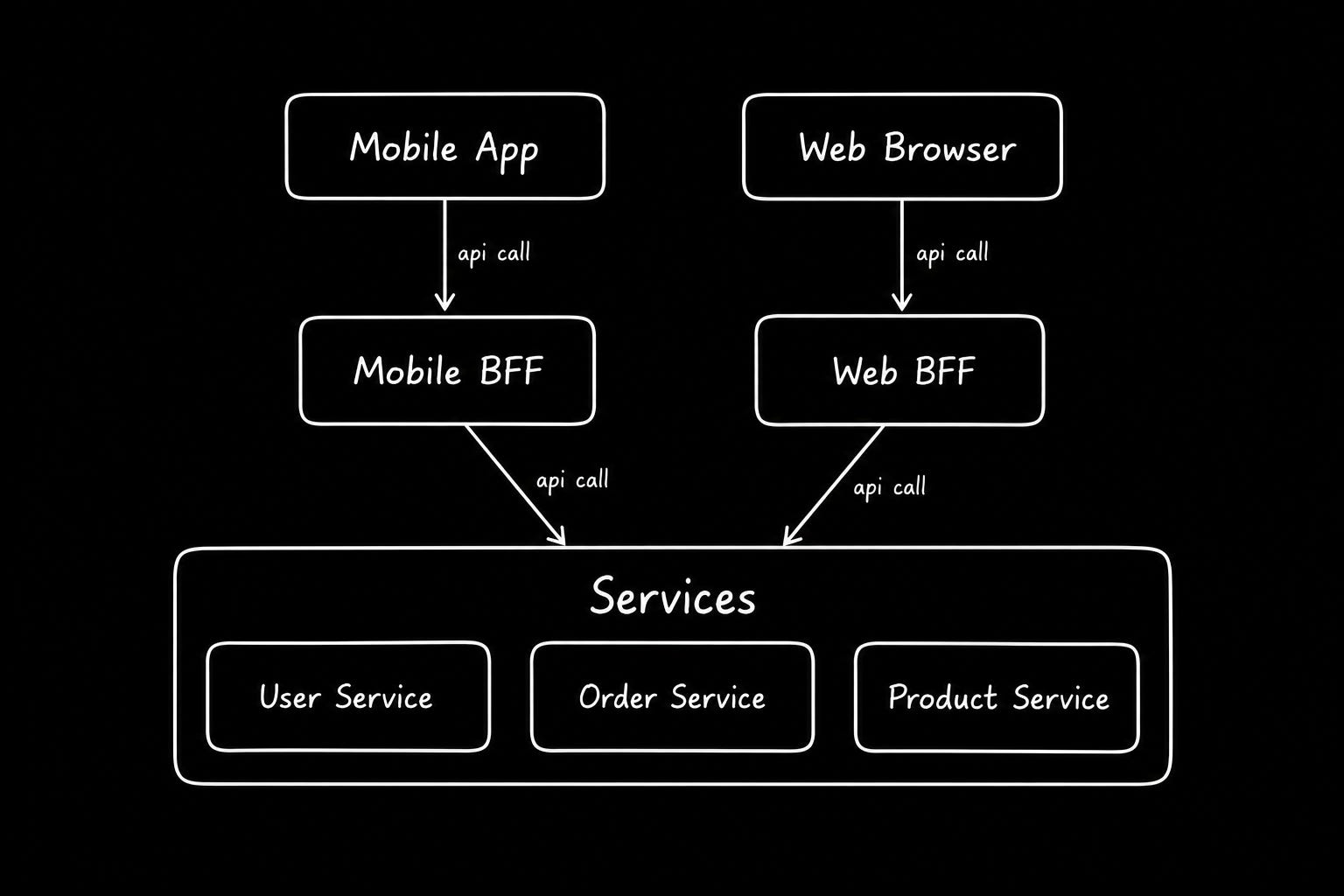
Use the Backend for Frontend (BFF) pattern to replace many API calls with a single call from the mobile app.
BFF gives each client type its own gateway, shaped around what the client needs.
The BFF calls the required backend services in parallel where possible, combines their responses, and returns only the data the mobile screen needs. You can also create a separate BFF for the web application, as it may have different data requirements.
This reduces network round trips, minimizes payload size & simplifies client-side logic.
Tips for a strong answer
Name the pattern: a backend built for one client experience.
BFF calls the services in parallel and returns one response sized for the screen.
It trims fields for mobile to save data and battery life.
The engineers who build the app also own its BFF, so both change together.
Mention GraphQL as an option, as it lets the client ask for exact fields it needs.
Likely follow-up
“You have web, iOS, and Android apps. One BFF or three?”
One per experience, not one per platform. iOS and Android share screens, so one mobile BFF serves both. Web gets its own.
Split further only when the needs truly differ.
Common mistake
Letting business rules creep into each BFF. The same pricing rule then lives in three places and drifts apart. A BFF should shape data, not make business decisions.
8. Bulkhead
“One slow downstream service is taking down your whole service.
Why and how do you stop it?”
Explanation
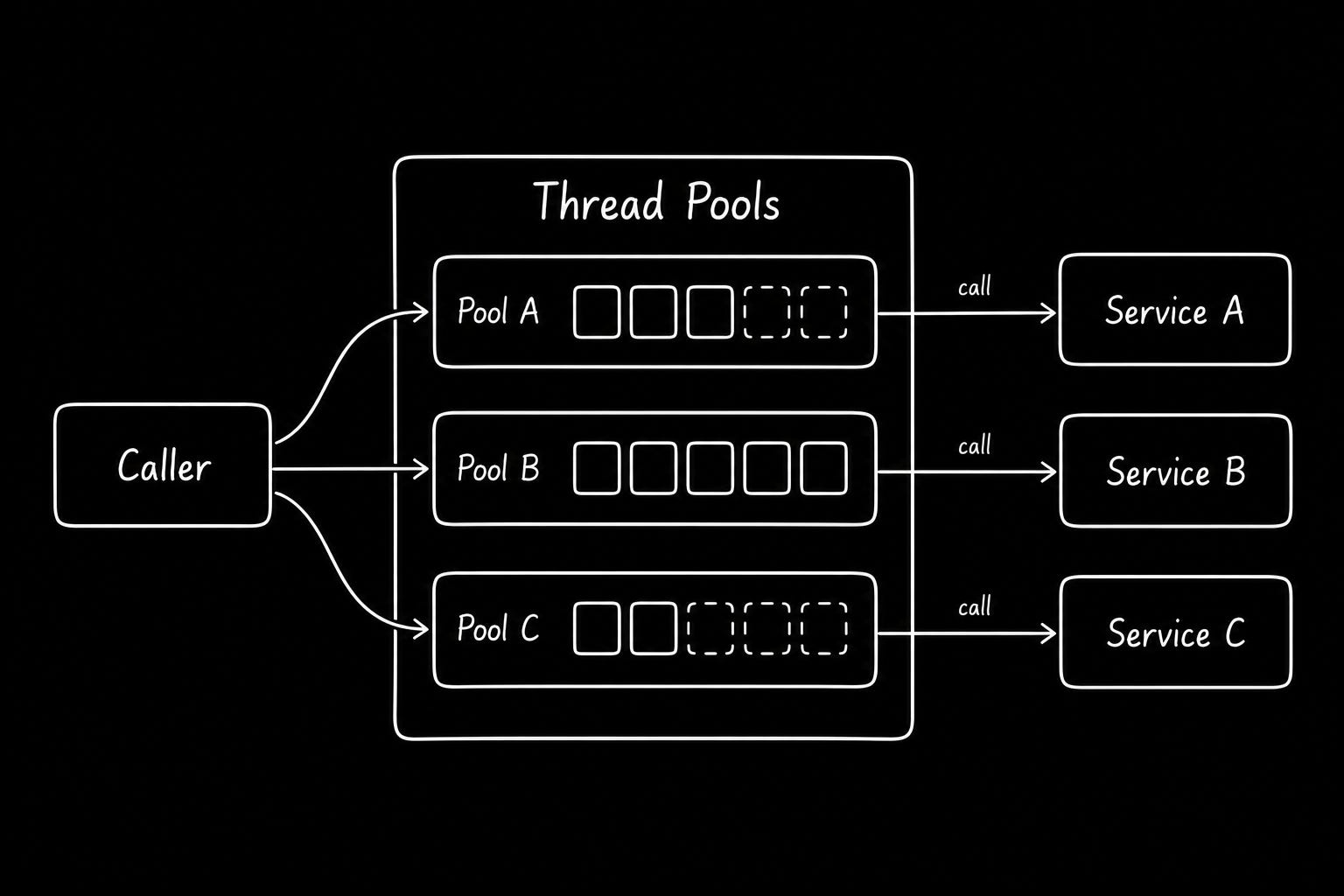
A slow downstream service can exhaust shared resources, such as threads or connections, leaving no resources available to communicate with healthy services.
Use the Bulkhead pattern to isolate resources by giving each downstream service its own thread pool and/or concurrency limit.
If one downstream service becomes slow or unresponsive, it exhausts only its allocated resources while other services continue to operate normally.
Combine bulkheads with timeouts to release blocked resources & prevent cascading failures.
Tips for a strong answer
Explain the cause: slow calls hold every thread in a shared pool.
Give each downstream service its own pool or concurrency limit.
Combine bulkheads with timeouts, so stuck threads free up.
Apply the same idea at a larger scale--separate clusters for critical traffic.
Likely follow-up
“How big should each pool be?”
Work it out from load tests. Calls per second times normal response time gives the number of calls in flight at once. Add some headroom, then cap it. Watch rejected calls in production and then fine-tune.
Common mistake
Only adding more threads. A bigger shared pool delays the failure but doesn’t stop it.
9. Service registry
“Instances of your service start and stop all day.
How do other services know where to send requests?”
Explanation
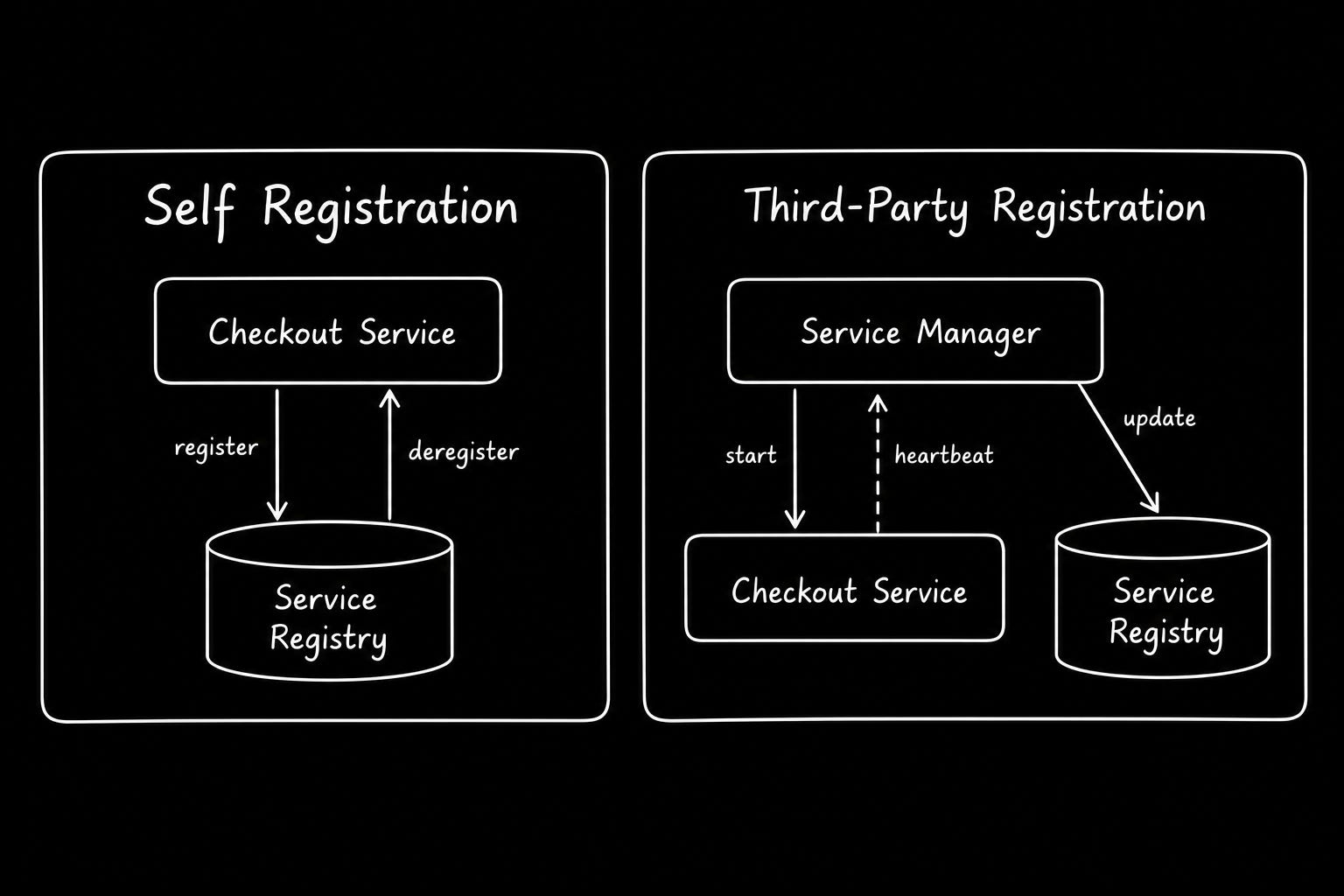
Use a service registry6 to maintain an up-to-date list of running service instances and their network addresses.
When an instance starts, it registers its address with the registry. When it shuts down, it deregisters itself. Regular health checks help identify and remove unhealthy instances. Other services query the registry to discover available instances and send requests to them.
This allows service instances to start, stop, and move between machines without requiring callers to update hard-coded addresses.
Tips for a strong answer
Describe the registry as a directory of live instances and their addresses.
Name both styles: self-registration and third-party registration.
Health checks or heartbeats remove dead instances.
The registry must stay up, so run it as a cluster with replicated data.
Callers cache the instance list, so they keep working through short registry outages.
Likely follow-up
“What happens if the registry goes down?”
Callers keep using their cached instance lists, so existing traffic still flows. But new instances can’t register, and dead ones aren’t removed. The caches slowly go stale. Running three or five registry nodes means one failure doesn’t stop lookups.
Common mistake
Hard-coding addresses, or using DNS records with long cache times. Containers move and addresses change, so stale entries send traffic to dead instances.
10. Two-phase commit
“How does two-phase commit work, and why do microservices usually avoid it?”
Explanation
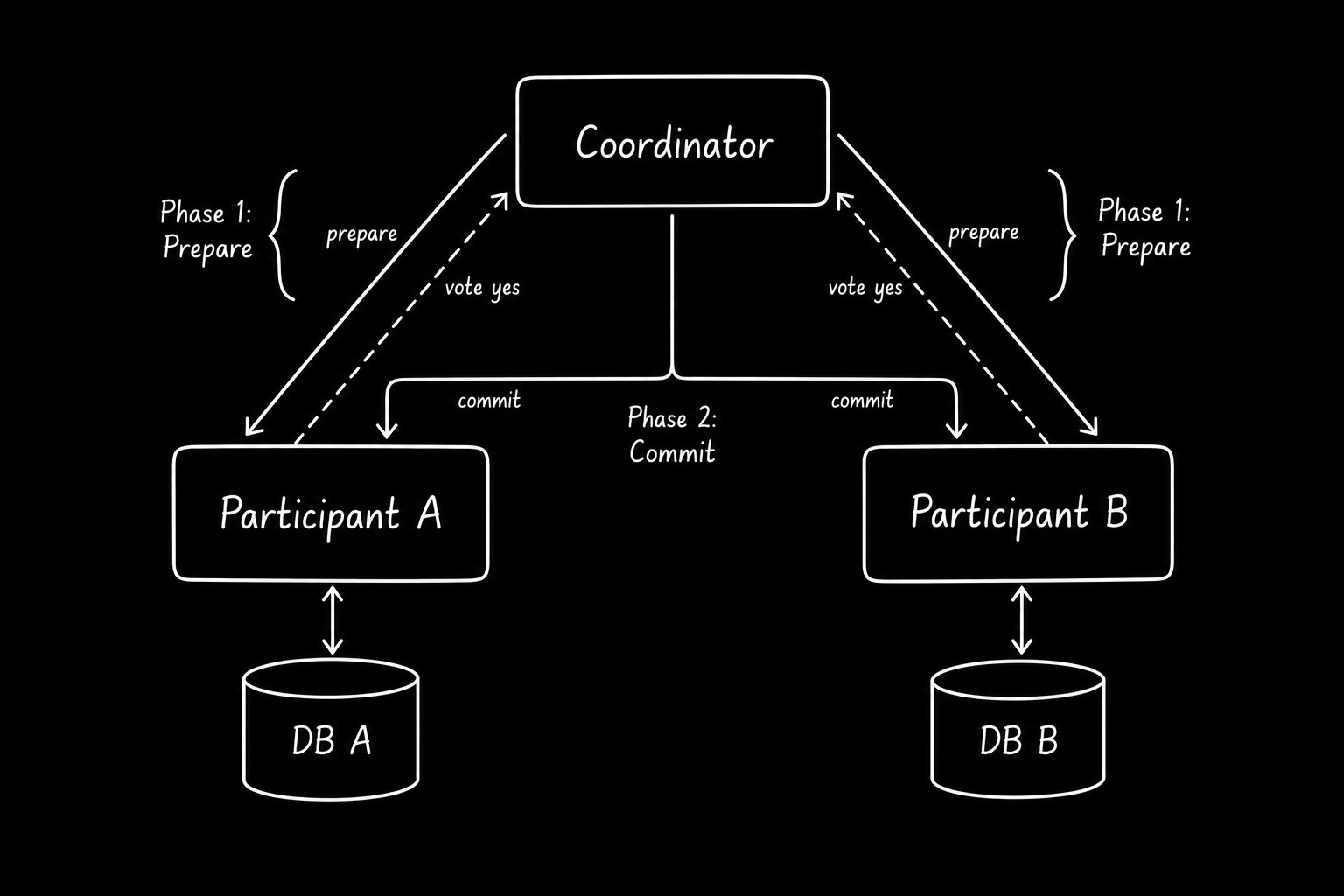
Two-phase commit (2PC) is a protocol where a coordinator gets every database to agree before any of them commits.
In the prepare phase, the coordinator asks each participant to get ready. Each one writes the change to disk, locks the rows, and votes yes/no.
In the commit phase, the coordinator counts the votes. All yes means commit everywhere. Any no, or any timeout, means roll back everywhere.
Tips for a strong answer
Walk through both phases: prepare and vote, then commit or rollback.
It gives all-or-nothing results across databases.
Participants hold locks through both phases, which slows everything down.
Many modern databases and brokers don’t support XA transactions.
It still works well within one trusted system.
Likely follow-up
“The coordinator crashes after everyone votes yes. What happens?”
The participants are stuck. They can’t commit or roll back on their own, so they hold their locks until the coordinator recovers and reads its log.
This blocking is 2PC's main weakness.
Common mistake
Saying 2PC keeps the system both consistent and available. It gives up availability to stay consistent.
11. Configuration manager
“How do you change a setting across 200 services without redeploying them?”
Explanation
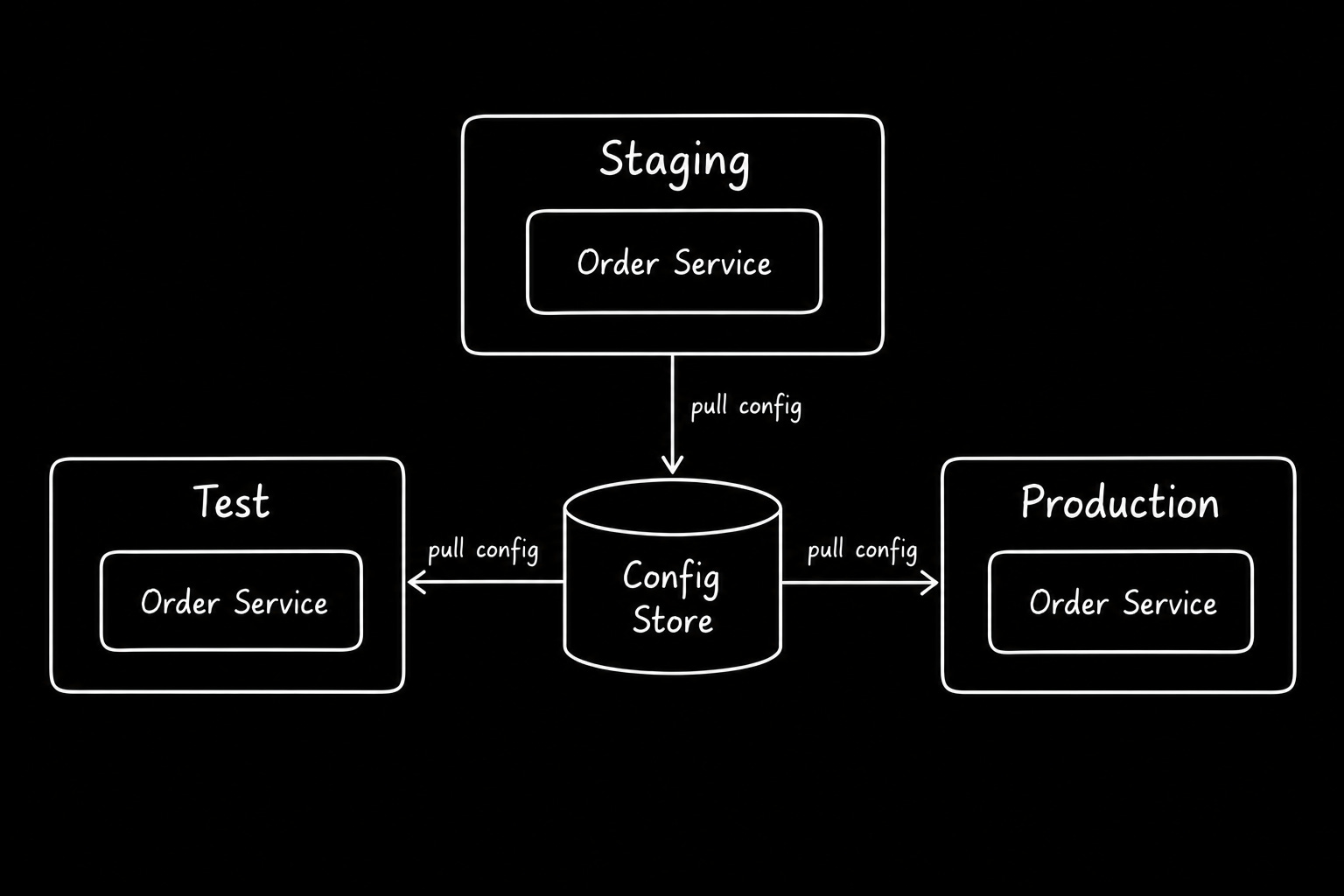
Use a centralized configuration manager7 to store & update settings for all 200 services.
Each service loads its configuration at startup and either watches for changes or periodically checks the configuration store for updates.
When you change a setting, such as a feature flag or log level, the services reload the updated value at runtime without requiring a redeployment. Also keep configuration changes versioned, so you can quickly roll back if something goes wrong.
Note: some settings may still require a service restart.
Tips for a strong answer
Use one central store, with values per environment and full version history.
Services read settings at startup and reload them when they change.
Control who can view or edit each value, per service and per environment.
Keep secrets like passwords in a separate vault, encrypted & rotated.
Roll out risky changes to a few instances first through feature flags.
Likely follow-up
“A bad config value took down production. How do you prevent a repeat?”
Check every value against a schema before it goes live. Roll changes out to a small group of instances first. Keep version history, so you can roll back in seconds. Treat config changes like code, with review and an audit log.
Common mistake
Storing passwords and API keys with ordinary settings, or committing them to git. Interviewers expect you to keep secrets separate.
12. Monolith first
“Your startup’s founder wants to launch with 20 microservices. What do you say?”
Explanation
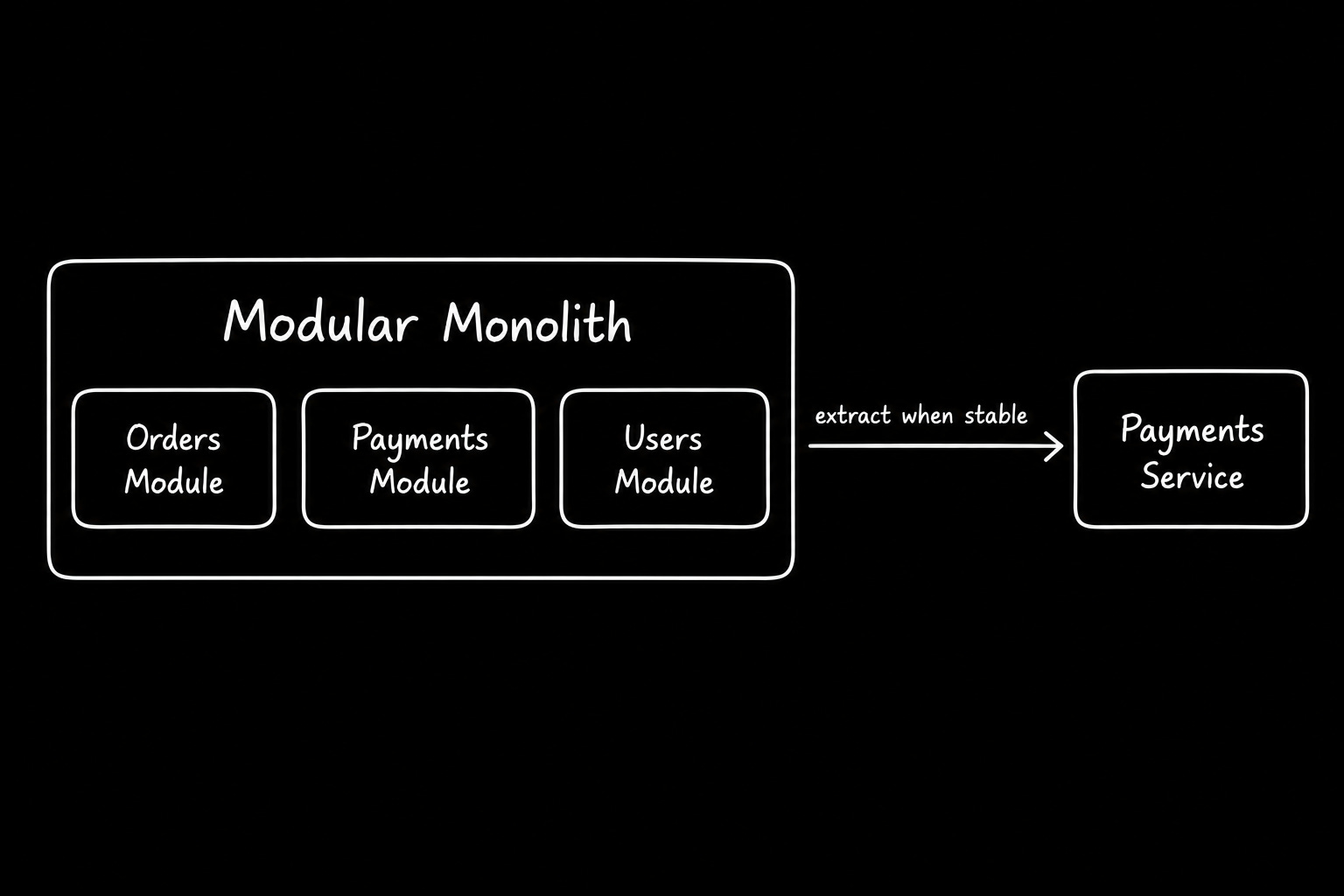
Monolith first. You start a new product as a well-structured monolith and split it into services only when complexity demands it.
A new product changes shape every few weeks. Splitting it into services too early locks in boundaries you’ll soon regret. A modular monolith keeps clean internal modules inside one deployable unit.
Once a module grows stable and busy, you extract it into its own service.
Tips for a strong answer
Push back with reasons: domain is still unknown, boundaries will move, and 20 services need costly tooling.
Propose a modular monolith with enforced module boundaries.
Agree on the signals for extracting a service: scale, release speed, or group ownership.
Name the strangler fig pattern8: route traffic for one feature to a new service and retire the old code bit by bit.
Likely follow-up
“How do you stop a modular monolith from turning into a tangled mess?”
Enforce boundaries in code.
Each module exposes a public interface, and other modules can’t touch its internals. Tools like ArchUnit or Spring Modulith fail the build when a module breaks the rules.
Each module also owns its own tables, with no joins across modules.
Common mistake
Treating monolith first as “monolith forever.” It’s a starting point with a plan to extract services later. Without enforced boundaries, the plan never happens.
Contribute to the conversation by sharing your insights & experiences:
13. Try-confirm-cancel
“How would you book a hotel room and a flight so the customer gets both or neither?”
Explanation
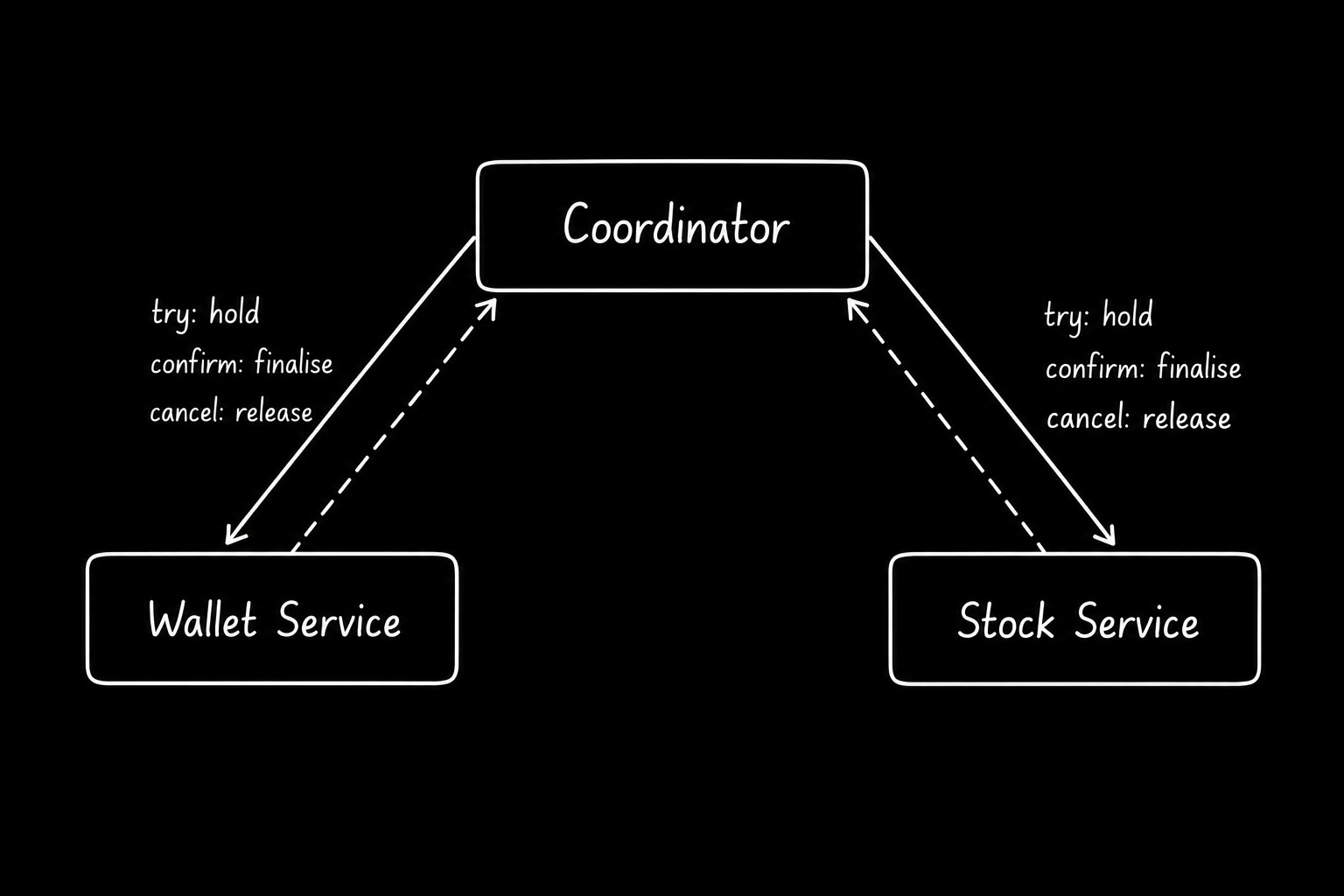
Try-confirm-cancel (TCC) is a pattern where each service first reserves resources, then confirms or releases them.
In the try step, each service checks and holds what it needs. If every try succeeds, each service runs confirm and makes the change final. If any try fails, each service runs cancel and releases its hold.
Each service writes its own try, confirm, and cancel code.
Tips for a strong answer
Try holds the room and the seat. Confirm books them. Cancel releases them.
Holds are business records, so no database locks remain open between steps.
A coordinator decides whether to confirm or cancel.
Holds expire after a timeout, so a crash doesn’t block stock forever.
Make confirm and cancel idempotent since the coordinator will retry them.
Likely follow-up
“How is TCC different from a saga?”
TCC holds first and commits later, so nothing is final until confirm. A saga commits each step at once and undoes it if a later step fails.
TCC keeps other requests from seeing half-done work. A saga suits longer workflows.
Common mistake
Saying TCC needs no coordinator. Something has to decide to confirm or cancel for every part. Frameworks like Apache Seata run the coordinator for you.
14. Conway’s law
“How should you organize engineers around microservices?”
Explanation
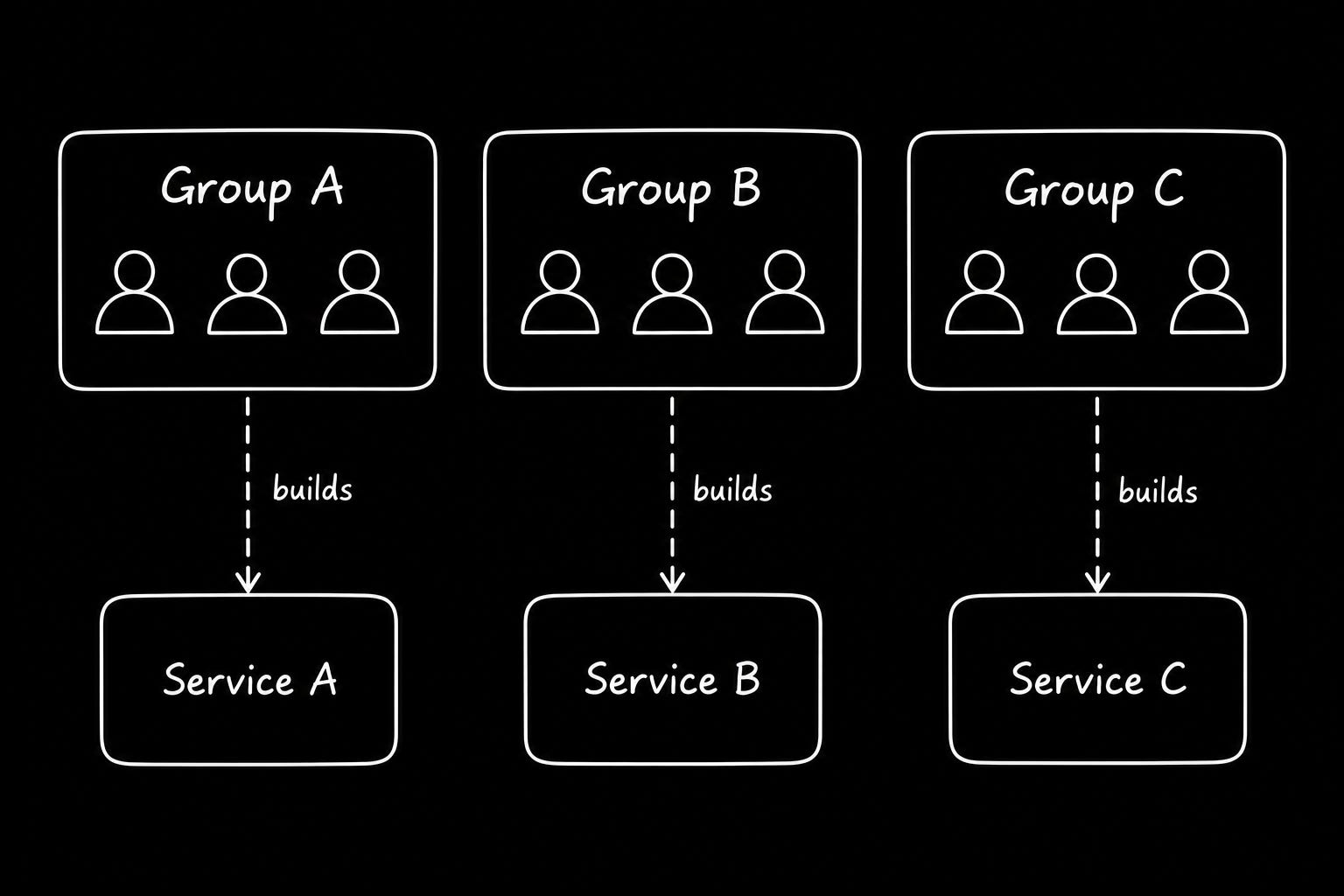
Conway’s law says that a system’s design mirrors the communication structure of the organization building it.
Put three groups of engineers on one compiler, and you get a three-pass compiler. Services follow the same rule. If two groups share one service, its code splits along their lines.
If one group owns five services, those services tend to blur together.
Tips for a strong answer
One group owns each service from design to production.
Group boundaries should match service boundaries, or the code will drift toward the org chart.
Avoid shared ownership. A service with two owners has no real owner.
Mention the inverse Conway maneuver: shape the groups first to get the architecture you want.
Likely follow-up
“What happens to the services after a reorganisation?”
The services keep their old boundaries while the groups change.
Ownership blurs & changes slow down. Give every service one clear owner, record it in a service catalog, and plan to merge or split services that no longer fit.
Common mistake
Treating Conway’s law as trivia. Interviewers want you to link it to design, such as why a shared service with five owning groups becomes slow to change.
Final Words
Every question in this guide tests one skill: explaining tradeoffs out loud.
Three habits will sharpen every answer:
Explain the failure first. Say what breaks before you name the pattern that fixes it.
Name the cost. Every pattern adds delay, code, or extra parts. Say which ones.
Answer the follow-up early. Mention the edge case, such as a failed refund or a stale cache, before the interviewer asks.
Then practice.
Pick questions from these guides (here’s part 1), and set a timer for three minutes each. Answer them out loud, and record yourself. Listen back for the vague parts and fix those first.
If you find this newsletter valuable, share it with a friend, and subscribe if you haven’t already. There are group discounts, gift options, and referral rewards available.

Want to reach 250K+ tech professionals at scale? 📰
If your company wants to reach 250K+ tech professionals, advertise with me.
Thank you for supporting this newsletter.
You are now 250,001+ readers strong, very close to 251k. Let’s try to get 251k readers by 27 November. Consider sharing this letter with your friends & get rewards.
Y’all are the best.

References
Martin Fowler and James Lewis, Microservices:
Martin Fowler, MonolithFirst: https://martinfowler.com/bliki/MonolithFirst.html
Martin Fowler, BoundedContext: https://martinfowler.com/bliki/BoundedContext.html
Martin Fowler, CircuitBreaker: https://martinfowler.com/bliki/CircuitBreaker.html
Melvin E. Conway, How Do Committees Invent? https://www.melconway.com/Home/Committees_Paper.html
Sam Newman, Backends For Frontends: https://samnewman.io/patterns/architectural/bff/
Chris Richardson, Pattern: Database per service: https://microservices.io/patterns/data/database-per-service.html
Netflix, Eureka: https://github.com/Netflix/eureka
HashiCorp, Consul documentation: https://developer.hashicorp.com/consul/docs
Kubernetes, Service: https://kubernetes.io/docs/concepts/services-networking/service/
Spring, Spring Cloud Config: https://docs.spring.io/spring-cloud-config/reference/
Istio, What is a service mesh: https://istio.io/latest/about/service-mesh/
OpenTelemetry, Documentation: https://opentelemetry.io/docs/
Benjamin H. Sigelman et al., Dapper, a Large-Scale Distributed Systems Tracing Infrastructure: https://research.google/pubs/dapper-a-large-scale-distributed-systems-tracing-infrastructure/
RFC 6585, Additional HTTP Status Codes: https://www.rfc-editor.org/rfc/rfc6585
Roy Fielding, Architectural Styles and the Design of Network-based Software Architectures: https://ics.uci.edu/~fielding/pubs/dissertation/top.htm
gRPC, Introduction to gRPC: https://grpc.io/docs/what-is-grpc/introduction/
Amazon Builders’ Library, Timeouts, retries, and backoff with jitter: https://aws.amazon.com/builders-library/timeouts-retries-and-backoff-with-jitter/
Netflix, Hystrix: https://github.com/Netflix/Hystrix
Resilience4j, Bulkhead: https://resilience4j.readme.io/docs/bulkhead
PostgreSQL, PREPARE TRANSACTION: https://www.postgresql.org/docs/current/sql-prepare-transaction.html
Apache Seata, TCC Mode: https://seata.apache.org/docs/user/mode/tcc/
Hector Garcia-Molina and Kenneth Salem, Sagas: https://www.cs.cornell.edu/andru/cs711/2002fa/reading/sagas.pdf
Werner Vogels, Eventually Consistent: https://queue.acm.org/detail.cfm?id=1466448
Use exponential backoff with jitter: Give the failing service time to recover and prevent clients from retrying simultaneously.
Cap the number of retries: Prevent endless retries from wasting resources and overloading the downstream service.
Retry only idempotent operations: Prevent unintended duplicate effects, such as charging a customer twice or creating duplicate orders.
gRPC (gRPC Remote Procedure Call) is an open-source, high-performance communication framework developed by Google. It lets applications on different machines call each other's functions as if they were local.
Two-Phase Commit (2PC): All participating databases prepare the transaction and commit only if every participant agrees.
Saga: Each service commits its own local transaction. If a step fails, compensating transactions undo the completed steps.
Try-Confirm-Cancel (TCC): Each service reserves resources first. If all reservations succeed, confirm them. Otherwise, cancel the reservations.
Contract testing: Verifies that a service continues to meet the API expectations of its callers after a change.
API versioning: Introduces a new API version while keeping the old version available for existing callers.
Canary deployment: Releases a new version to a small percentage of traffic before gradually rolling it out to everyone.
Blue-green deployment: Runs old and new versions in separate environments, allowing traffic to switch between them for quick deployment or rollback.
A service registry is a live directory that stores every running service instance and its network address.
A configuration manager is a central store for service settings, read by services at startup and while they run.
The Strangler Fig pattern is a migration strategy that gradually replaces a monolith with microservices without shutting down or rewriting the entire application at once.
Start with an e-commerce monolith.
Extract the payment functionality into a new microservice.
Route payment requests to the new microservice through an API gateway.
Keep other requests going to the monolith.
Repeat for other functionalities as needed.
Retire the old code once its functionality has been migrated.
This reduces migration risk, avoids major downtime, and allows you to migrate incrementally while keeping the application operational.